
Three to five posts a week is the defensible range; Facebook fatigue has never been measured, and our 51-store study found no per-post penalty for volume.
Each figure below carries a label saying how much weight it can hold. [Measured] means a named study with a real sample stands behind it. [Stated by Meta] means the platform's own published rule or figure. [Trade] means consistent practitioner reporting. [Not measured] means the industry repeats it and nobody has measured it.
One of a series at myjewelrymarketing.com checking which parts of the advice given to independent jewelers anybody has measured; the wider picture is in the state of independent jewelry retail in 2026.
The four answers in circulation, and why they cannot all be right
Ask how often to post on Facebook and the published answers are not variations on a number — they are contradictions:
- Buffer's guide says once a day, "one to two" at the top end — resting on a single HubSpot study of 13,500 users, cited secondhand. [Survey — via Buffer]
- Dash Social observes about nine posts a week for brands under 100,000 followers, the reference class a store actually belongs to. [Measured]
- Sprout Social says three to four high-value posts a week beat daily posting. [Trade]
- Socialinsider's 2026 report observes 39 posts a month on one page and 24 on another — the same publisher, the same report, two numbers. [Measured, and self-contradicting]
This is the same pattern we found with posting times: when the published answers disagree this much, the honest conclusion is that nobody is measuring the thing they are recommending.
"Facebook fatigue" has never been measured
Here is the finding this article exists for: no study has ever measured whether posting too often wears out a Facebook audience. Not a reach-decay curve, not an unfollow threshold, not a diminishing-returns analysis. [Not measured]
The revealing detail is who admits it. Buffer publishes posting-frequency performance curves for Instagram, TikTok and LinkedIn — real analyses of what happens to per-post results as accounts post more. For Facebook it publishes no such curve, and its Facebook recommendation leans on that one secondhand survey. The vendor most willing to measure frequency has daily advice for Facebook and no Facebook data under it.
So when someone tells you five posts a day is too many — or that daily posting is mandatory — ask what measurement they are reading. There isn't one, in either direction.
Where fatigue is real: ads, where exposure is forced
Fatigue as a phenomenon is not imaginary. It is measured — in advertising, where the platform forces the same creative in front of the same person repeatedly. Ad platforms sell frequency caps as a product precisely because response declines with repetition, and there is academic work on optimising those caps. [Measured — in paid advertising] Vendor-circulated benchmarks put the click-through decline at roughly 40–50% by the fourth exposure; we treat those as vendor figures rather than gospel, but the direction is beyond dispute.
The reason this does not transfer to organic posting is mechanical. An ad is pushed at a person; an organic post is ranked. Your followers do not see everything you publish — the feed selects per person, by predicted interest. A store posting five times a day is mostly not fatiguing its audience; it is publishing five posts that compete with each other for the same handful of impressions, with the algorithm quietly discarding the rest. That is reasoning from Meta's published distribution mechanics, not a measurement, and we label it so. [Not measured — mechanism]
Meta's only stated line is about spam, not fatigue
Meta does restrict accounts that post "at very high frequencies" — its spam policy says so directly — and its April 2025 crackdown cut reach for spammy patterns. [Stated by Meta] But read the policy: it is aimed at coordinated spam operations posting repetitive content at network scale. A jewelry store posting four times a day is nowhere near that line. The store's problem is not a penalty. It is that the extra posts buy almost nothing.
What is measured: consistency, and an accidental industry-wide experiment
Two real findings survive scrutiny, and neither is about posting more.
Consistency is measured, and the effect is large. Buffer analysed over 100,000 accounts across ten platforms over six months: accounts that posted at least once a week in 20 or more of 26 weeks earned more than five times the engagement per post of inconsistent accounts. [Measured] Note what was counted — weeks with at least one post, not post volume. The measured winner is showing up every week, not flooding any given day. (Facebook is in the sample but not broken out separately.)

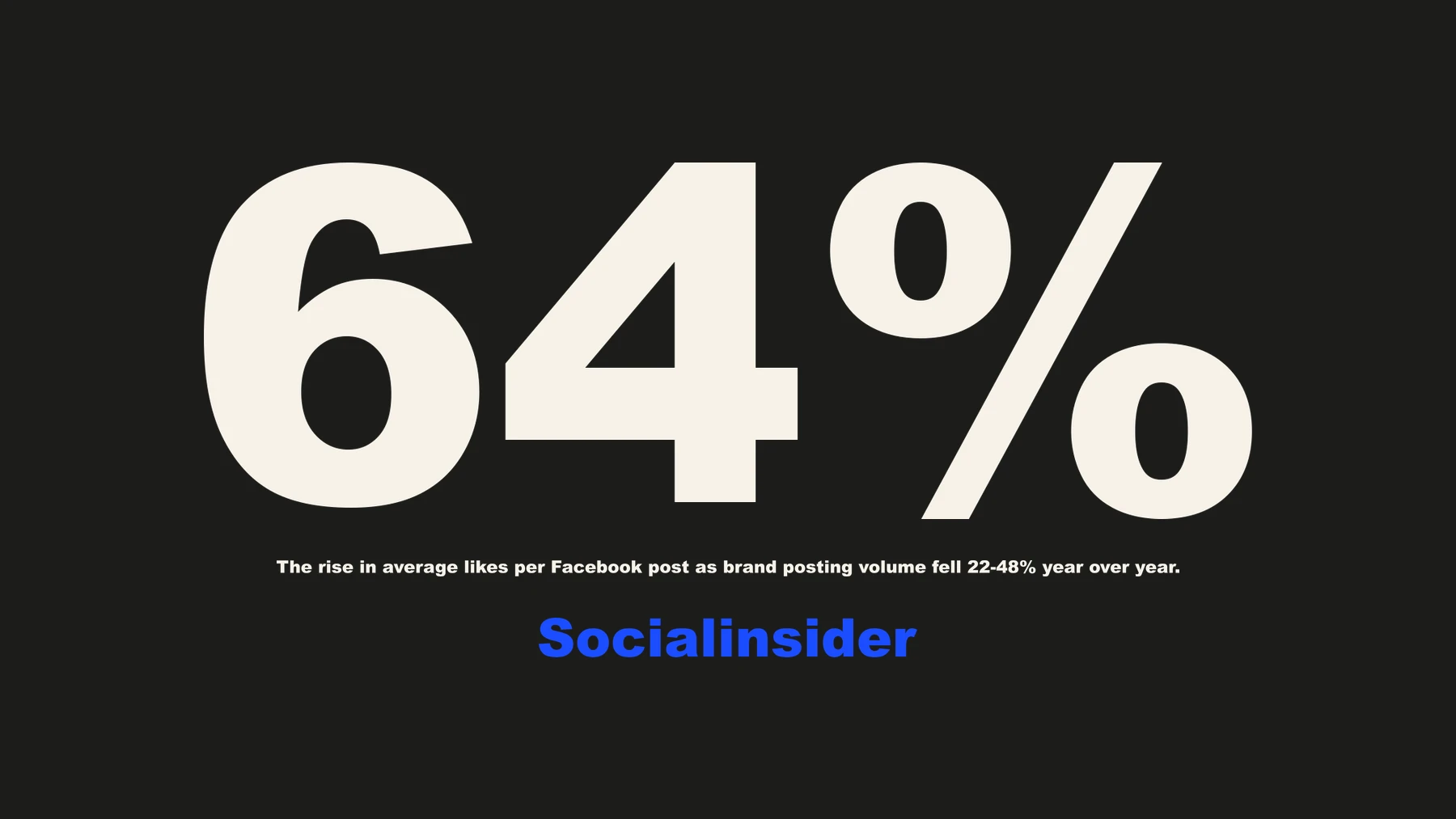
And the industry just ran the volume experiment for you. Across the benchmark datasets, brand posting volume on Facebook fell 22–48% year over year. Engagement rate held flat — and average likes per post rose 64%. [Measured] Everyone posted less; nobody's engagement collapsed; each post earned more. That is not a controlled study of fatigue, but it is the opposite of what "post more or the algorithm forgets you" predicts.
What 51 jewelry stores actually did last holiday season
Because no vendor breaks out jewelry, we measured it ourselves. myjewelrymarketing.com's Holiday Season Study captured every public post from the Facebook pages of small and mid-sized independent jewelers — twenty per US sales territory, resolved from each store's own website — across the full holiday window, 1 November 2025 to 28 February 2026. Three of twelve territories are captured so far: 61 stores, of which 51 were active, publishing 3,738 posts between them. Engagement is counted as reactions, because that is all a public page exposes — it measures response, not reach, and a boosted post is indistinguishable from an organic one. [Measured — our own study]
Three findings bear directly on this question:
- The median active store posted 4 times a week across the seventeen-week season — the middle half of stores sat between 2.6 and 6.3. Real jewelers, in their busiest season, already post at roughly the cadence this article recommends.
- The highest-volume quarter of stores earned a median 6 reactions per post. The lowest-volume quarter also earned 6. Within this sample, posting a lot carried no per-post penalty — the nearest thing to a direct fatigue test that exists for this trade, and it found none. It also carried no per-post bonus: the extra posts earned about the same each, no more.
- Nobody actually posts "five times a day." The loudest store in the capture averaged about 10.6 posts a week; the quietest active store posted 8 times in the entire season. The multiple-times-daily jeweler the advice argues about barely exists in the wild.

Read those together and the picture is consistent with the industry-wide data above: volume neither poisons nor multiplies per-post response, so the question is not "does posting more hurt" but "is another post the best use of the hour" — and the humbling context is that the median reaction count on all 3,738 posts was five. The full study, covering all twelve territories, will be published on this blog when the capture completes; these figures are from the three-territory snapshot of 28 August 2026.
One more measured fact that should give a retailer pause: retail already posts more than almost any other vertical — 6.4 posts a week against an all-industry median of 3.0 — on the platform where retail's engagement rate ranks near the bottom. [Measured] The category is over-supplying content into a channel that under-rewards it. Posting more is not the untried lever; it is the tried one.
So: how many times a month?
Thirteen to twenty-two posts a month — three to five a week — every week, without missed weeks. That range sits inside every credible reference point above, is sustainable enough to hit the one lever that is actually measured (weekly consistency), and leaves the effort for the things with real effect sizes behind them:
- Four good slots beat seven thin ones: an album, a Reel with your voice in it, a customer story, and one conversation or Event a week. Albums carry reach to your own followers; the Reel is the discovery play.
- The fifth post is worth less than ten minutes of replies. Replying to comments lifted reactions about 9.5% in a million-post study — the only zero-cost tactic with a measured Facebook effect. [Measured]
- December is the exception: the trade consensus there is daily, for one month, with the season's own content to fill it. [Trade]
- If you currently post multiple times a day, drop to one and watch your own per-post numbers for a month. The industry-wide data says you will lose little and each post will earn more; your own Insights are the only jewelry-specific test that exists.
What this article does not tell you
- We cannot prove fatigue is false, only that nobody has measured it. A claim with no measurement is unknown, not disproven — and unknown is not a thing to build a daily-posting habit on, either.
- The consistency study measures engagement per post across ten platforms, on one scheduler's user base, with no Facebook-only cut.
- Our own study measures reactions, not reach, on 51 stores in one holiday season across three territories so far. It cannot see who scrolled past without reacting, and a boosted post looks organic in it. It is the only jewelry-specific cadence measurement we know of, which is a reason to hold it carefully, not a reason to lean harder on it.
The short version
Nobody has ever measured "Facebook fatigue" — no reach-decay curve, no unfollow threshold, nothing, and the vendor recommending daily posting publishes frequency curves for three other platforms but none for Facebook. Fatigue is real and measured only in ads, where exposure is forced; an organic feed ranks instead, so extra daily posts mostly compete with each other for the same impressions. What is measured: weekly consistency multiplies engagement per post about fivefold, the industry cut posting volume 22–48% last year and likes per post rose 64%, and retail already over-posts at 6.4 a week against a 3.0 median. The defensible answer for a jewelry store is three to five posts a week — thirteen to twenty-two a month — every single week, with December's daily cadence as the one seasonal exception, and the time a sixth post would take spent replying to comments instead. Our own Holiday Season Study of 51 independent jewelers — 3,738 posts across last year's holiday window — found the median store already posts 4 times a week, the highest-volume quartile earned exactly the same median reactions per post as the lowest, and no store in the capture came anywhere near five posts a day.
Get this for your own store
The right cadence also depends on what you have to say — a store with a busy bench has more real material than a store reposting catalogs. The free strategy at myjewelrymarketing.com/demo/strategy builds a posting plan from your own trade area's published Census figures, week by week. Paste your website address and read it in a couple of minutes.
Sources
Compiled by My Jewelry Marketing — myjewelrymarketing.com.
- The consistency finding. Buffer, "Consistent Posting Means 5x More Likes, Comments, and Shares", 2026 — 100,000+ accounts, ten platforms, six months; consistency counted as weeks with at least one post, not volume; no Facebook-only breakout.
- The daily-posting recommendation and its basis. Buffer, "How Often to Post on Social Media" — recommends once a day for Facebook, citing a HubSpot study of 13,500 users; presents no Facebook-specific frequency data, unlike its Instagram, TikTok and LinkedIn analyses.
- Posting volume, engagement rate and likes per post. Socialinsider's Facebook benchmarks, 2026 — brand posting volume down 22–48% year over year across its datasets, engagement rate flat, average likes per post up 64%; note its two observed-cadence figures (39 and 24 posts per month) disagree within the same report.
- Retail's posting rate against the median. Rival IQ, 2025 Social Media Industry Benchmark Report — retail 6.4 posts per week against an all-industry median of 3.0.
- The reference-class cadence. Dash Social, brands 0–100K followers, roughly nine posts per week observed.
- Meta's frequency line. Meta, Community Standards: Spam — restrictions on posting "at very high frequencies" — and Meta Newsroom, "Cracking Down on Spammy Content on Facebook", April 2025.
- Ad-side frequency fatigue. Naor et al., "Soft Frequency Capping for Improved Ad Click Prediction in Yahoo Gemini Native" — the academic anchor for response declining with repeated forced exposure; platform frequency caps exist for the same reason. Vendor-circulated decline percentages are treated as vendor figures.
- The reply lift. Buffer's reply study — +9.5% reactions, 1M+ posts across 97,427 Pages, fixed-effects, p < 0.001.
- The jewelry-store cadence and quartile figures. My Jewelry Marketing's Holiday Season Study — every public post from the Facebook pages of small and mid-sized independent jewelers, twenty per US sales territory, 1 November 2025 to 28 February 2026; three of twelve territories captured at the 28 August 2026 snapshot quoted here (61 stores, 51 active, 3,738 posts). Engagement counted as reactions; response, not reach. The full study publishes on this blog when the capture completes.
- Organic Facebook fatigue. No reliable source exists. No study measures reach decay, unfollow rates or engagement decline as a function of organic posting frequency on Facebook, from any vendor, platform or academic source found in this research — our own study's quartile comparison is the nearest available evidence, and it found no per-post penalty.