
There is no measured best time to post — the golden hour has never been tested, and the vendor studies naming an hour contradict each other.
Each figure below carries a label saying how much weight it can hold. [Platform] means the platform's own published documentation, which outranks everything else here. [Measured] means a named study with a real sample. [Not measured] means nobody has measured it and the industry repeats it anyway. [Hypothesis] means a mechanism that fits the evidence but that no publisher has confirmed. Where a number is our own audit of somebody else's published methodology, it says so.
One of a series at myjewelrymarketing.com checking which parts of the advice given to independent jewelers anybody has measured; the wider picture is in the state of independent jewelry retail in 2026.
When is the best time for a jewelry store to post?
Honestly: nobody knows, and the question matters far less than you have been told.
If you want a defensible default for Facebook, Tuesday and Wednesday around midday store-local is the one thing the literature broadly agrees on — three independent publishers converge on those days, and noon to 1pm is the single hour every source has in common. Use it and stop thinking about it.
What you should not do is spend any further attention on the hour. Everything below explains why, and the short version is that the industry's central claim about timing has no measurement behind it, the studies that name an hour disagree with each other by up to fifteen hours, and not one of them will tell you how much difference it makes.
What is the "golden hour", and who measured it?
The claim is that the engagement a post collects in its first thirty minutes determines how far the platform will distribute it. It is the reason scheduling products exist in the shape they do.
Nobody has measured it. Not a platform, not a vendor, not an academic paper. We searched platform documentation, vendor research and academic databases specifically for a controlled or large-sample test of a first-thirty-minutes engagement-velocity effect, and there is none. No platform has ever named first-hour engagement as a ranking input. [Not measured]
That is a strong claim, so here is its shape: we are not saying the effect is false. We are saying that after looking for the study, there is no study — and a claim this load-bearing should have one.
Two platforms say the opposite, in their own words
This is the part that should settle it, because platform documentation outranks any vendor blog post about that platform.
YouTube, in its own performance FAQ:
Publish time is not known to impact a video's long-term performance.
And on the related folklore about upload schedules, from the same page:
Growth in views across uploads is not correlated with time between uploads.
[Platform]
Pinterest, in its business help documentation:
There's no set engagement window for Pins, so it's possible that a Pin can gain engagement hours, days, months, or even years after it's first published.
[Platform]
Both quotes are live in those platforms' own help pages, and we checked them directly rather than taking them from a secondary source. Note what follows from the Pinterest one in particular: Pinterest publishes no time-of-day guidance at all, which means every "best time to Pin" chart in existence is entirely vendor-generated, describing a platform that has told you there is no window.
The picture is not uniform across platforms, and it would be dishonest to pretend it is. TikTok's Transparency Center does list "the time the video was posted" among the signals its system knows about — but it is listed as an attribute of the video, most plausibly a freshness feature, and TikTok does not say which times are better. Instagram lists when a post was shared as a minor signal inside its feed ranking, and not at all for Reels, Explore or Stories. [Platform]
So: one platform says publish time does not matter, one says there is no window, one knows what time you posted but will not say which time is better, and one treats it as a minor input to the smallest of its surfaces. None of that is a golden hour.
The closest real finding is measured in days, not minutes
There is one large, properly-sampled study of how a post accrues attention over time, and it is worth knowing because it is routinely cited as though it supports the golden hour.
Socialinsider analysed six million TikTok posts from 72,000 accounts and found views surge hardest in the first one to five days after posting, with the lifecycle running twenty to thirty days. [Measured]
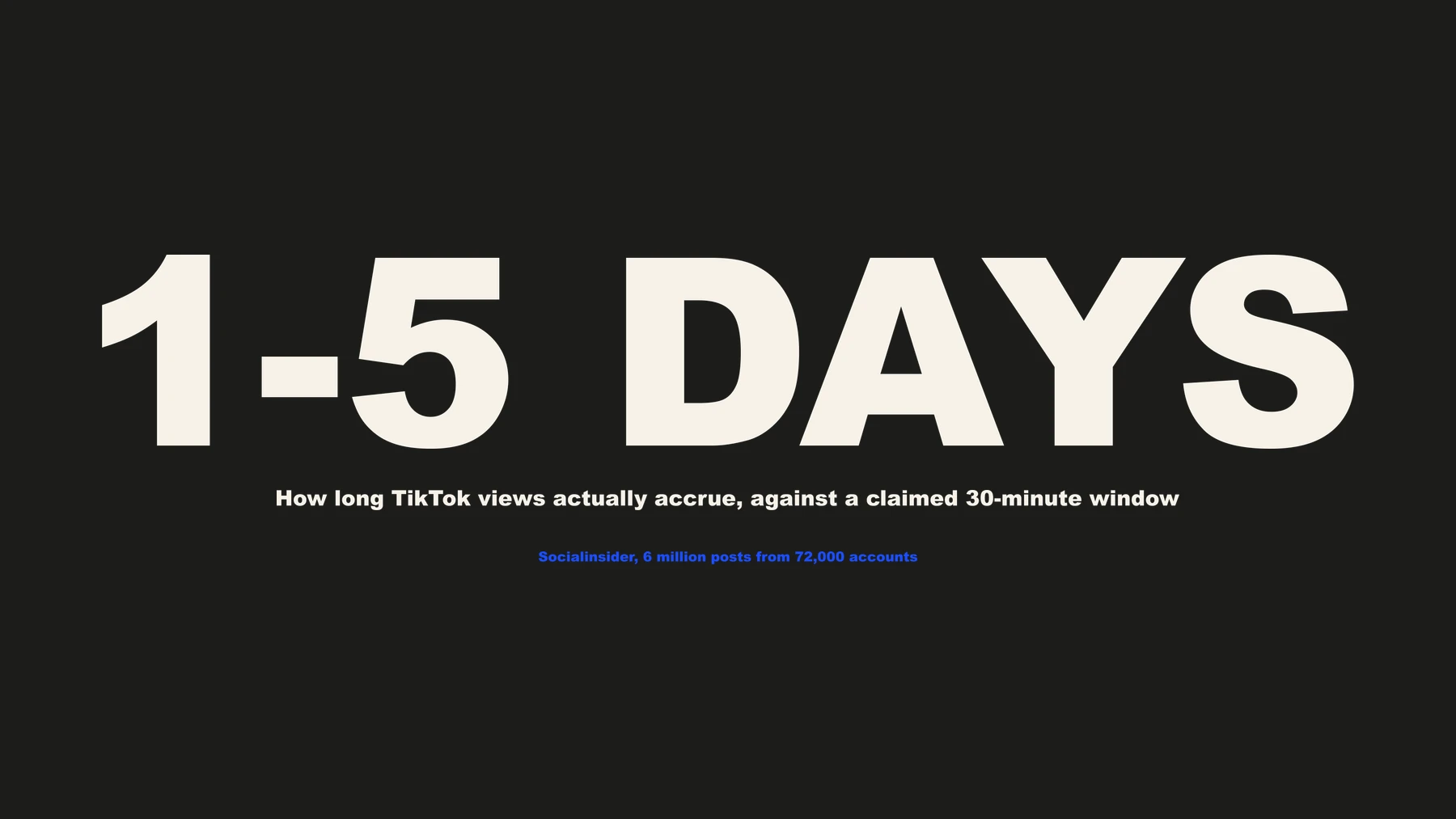
The claim circulates in two forms, so both comparisons are worth making: five days is 120 times longer than the hour the name refers to, and 240 times longer than the thirty-minute version. [Our arithmetic.] Either way it is a finding about which days matter, and it argues against expecting a Pinterest-style long tail on TikTok. It is not evidence for choosing an hour, and it certainly is not evidence that the first thirty minutes decide anything.
Seven studies, seven different answers
If posting time carried a large and stable effect, large samples would converge on it. They do the opposite. A few of the direct contradictions, all from published 2026 vendor studies:
- Facebook, Sprout Social says Tuesday and Wednesday 12–8pm. Hootsuite says Tuesday 5am. Those are seven to fifteen hours apart, and Sprout's single best window is Hootsuite's low-value one.
- Facebook, Buffer ranks Sunday third-best and Saturday worst. Sprout says Sunday engagement is "universally low". Directly opposed, same day.
- Facebook retail, Sprout publishes no evening window at all. Hootsuite retail makes 5–6pm its lead window. Social Champ makes Saturday 10am–2pm a primary window that Sprout's weekdays-only cut excludes entirely.
- Instagram — six vendors, six answers: Sprout Tue 1–7pm, Buffer Wed noon, SocialPilot 7am, Hootsuite Mon 3–9pm, Metricool Tue 8–9pm, Later Mon 5am.
- TikTok, Sprout says Tuesday to Thursday with weekends worst. Buffer ranks Saturday first and Sunday third, with Wednesday and Thursday weakest. That is a 180-degree inversion.
These are not small disagreements at the margin. They are mutually exclusive recommendations drawn from millions of posts each. The contradiction is itself evidence that the underlying effect is weak — a strong, stable signal does not produce seven incompatible readings.
Why they contradict: nobody defines the denominator
Here is the explanation, and as far as we can tell nobody else has published it.
We audited the methodology of every major best-time-to-post study. The finding:
- Not one of the major timing studies defines its engagement denominator. Not one states whether "best time" means the highest engagement rate or the highest raw engagement volume. [Our audit of published methodologies]
- Not one states whether it controls for how many posts were published in each hour. [Our audit]
- Of the studies that do disclose a formula, they are the benchmark reports rather than the timing ones. Socialinsider and Rival IQ divide by followers; Buffer's engagement benchmark divides by reach. Not a single timing study uses reach or impressions as its denominator — which matters enormously, because reach is the thing a store owner actually cares about.
That single omission explains the whole mess. [Hypothesis]
Studies that count total engagement will favour the hours when the most people are scrolling and the most posts exist — middays and evenings. Studies built on per-post engagement rate will favour low-competition early mornings, because the handful of posts published at 4am show unusually flattering ratios against a tiny denominator.
Look at where each vendor lands and the pattern holds: Sprout and Social Champ come out midday-to-evening; Buffer, Hootsuite, Later and Dash Social come out early morning or overnight. We label this a hypothesis rather than a finding for one reason — no primary publisher has confirmed it, because none of them discloses the denominator that would let you check.
The 1am recommendation that is not a finding
The clearest thing this artifact produces, and a useful test case for reading any timing chart you are shown.
One published study reports that retail's best time to post on Instagram is 1am. Read it as a per-post-rate artifact of a near-empty hour and it makes perfect sense: almost nobody posts at 1am, so the few posts that do face no competition, and a Reel published then accrues engagement all night before the ratio is taken.
Acting on it means posting to nobody at a flattering ratio. The number is real; the recommendation is not.
Nobody will tell you how much it is worth
This is the objection that ends the argument, and it is the one to remember.
Not one vendor in this field publishes an effect size. Nobody anywhere states that posting at the best time yields a given percentage more reach than posting at the worst time. We checked the major timing studies specifically for this and found none. [Not measured]
Without an effect size, no posting-time advice can be justified against literally any other use of your twenty minutes. If the answer is "3% more reach", it is not worth a scheduling subscription. If it is "300%", it is the most important thing in your marketing. Nobody will say which, and the reason to notice that is that every other recommendation on this blog comes with a magnitude attached.
The two largest vendors in the timing business also disclaim their own findings. Buffer, on its own best-time-to-post page:
sharing your social media posts at the "right" time is not the secret sauce for content success
Hootsuite's position is that your best time depends on your industry, audience habits and time zone — which is a way of saying their chart is not about you.
None of these studies measured a store like yours
Worth stating plainly, because it applies to every social media benchmark a jeweler is ever shown.
Not one published study in this field measures anything on jewelry retail accounts. Not Socialinsider, Rival IQ, Dash Social, Metricool, Buffer or Sprout Social, and no jewelry trade body publishes one either. [Not measured]
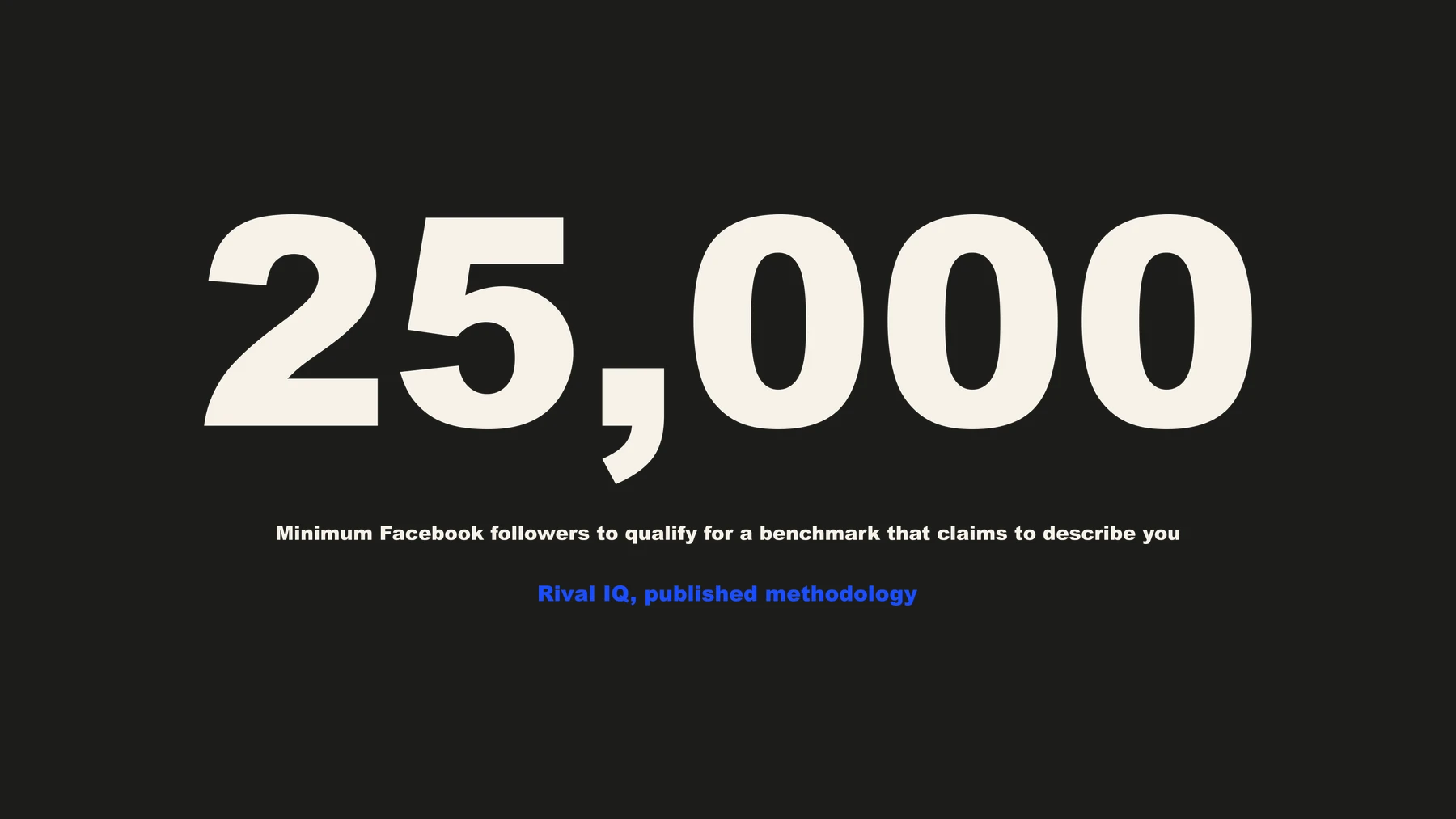
Worse, at least one benchmark methodology structurally excludes you. Rival IQ's requires Facebook fan counts between 25,000 and 1,000,000 — which means a single-location jeweler with four thousand local followers could not be in the sample under any circumstances. [Measured — published methodology]
The benchmarks describing "your industry" are describing national brands, and the timing cuts labelled "retail" are worse still: none of the three publishers offering a retail window defines what retail means. One merges consumer goods manufacturers with retailers. None discloses a retail sample size. None is measured on independent brick-and-mortar.
And the clock is optimising the wrong channel anyway
The structural point, and the reason this whole debate is dated.
Distribution has moved off the follower feed. Instagram views from non-followers rose from 30% to 49%, and TikTok For You Page views went from 31% in 2023 to 58%, with a separate study measuring 72.7% of TikTok views coming from the For You Page. [Measured]
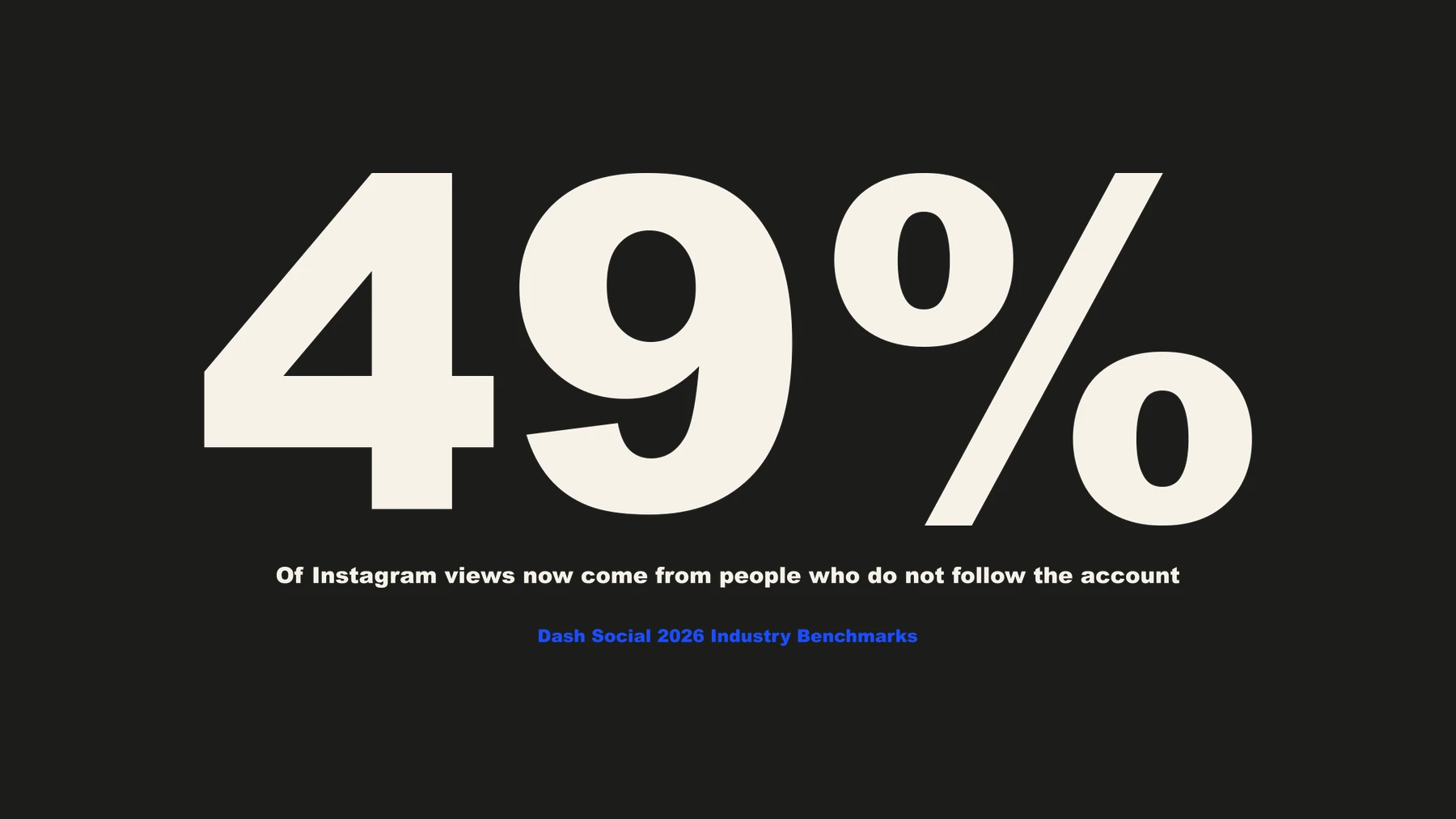
When roughly half of Instagram views and most TikTok views arrive through recommendation surfaces serving people who do not follow you, posting time is being asked to optimise the channel that now carries a minority of distribution. Recommendation surfaces have no clock relationship to when you pressed publish.
Instagram's own explanation for weak reach is not bad timing but asynchronous audiences: nobody reaches every follower, because many of them do not open the app the day you post. That is a structural argument that no single posting time reaches your audience, whichever one you pick.
So what should a jewelry store do instead?
Pick a default, stop optimising it, and put the attention into things with evidence behind them.
- Post Tuesday or Wednesday, late morning to early afternoon, in your own time zone. It is the most defensible default available. Set it once.
- Switch to your own numbers at six weeks. Your Page insights describe your actual customers in your actual town, which no national study does. A store's own audience-active hours beat any published chart the moment there is enough history to read.
- Never schedule for an hour when the store is shut. A post that lands while nobody can answer a comment is worse than one posted an hour later, and this consideration outranks every chart above.
- Put the effort into format instead. On a Facebook page under about ten thousand followers a multi-photo album out-reaches a Reel by roughly eight times — a far larger lever than any hour, and the whole table is in why photo albums beat Reels for small jewelry pages. Link posts underperform every other format by three to four times.
- Photograph your own inventory. Recycled and duplicated imagery is penalised, and the standard jeweler workflow — reposting the supplier's studio shot that four hundred other stores also posted — is the single most expensive habit in this list. Your own indifferent photo of a ring on a hand will out-reach it.
- Post more often rather than more precisely. If no single time reaches your audience, frequency is the answer the structure actually supports.
The honest summary is that the twenty minutes you would spend perfecting a posting schedule is better spent photographing a repair on the bench. That is a real finding; the golden hour is not.
What is not measured here
- The golden hour itself. We are reporting the absence of a study, which is not the same as disproving the effect. If a controlled measurement is ever published, this post should change. [Not measured]
- The denominator explanation is a hypothesis. It is mechanistically coherent and fits where every vendor lands, but no primary publisher has confirmed it — because none discloses the denominator. [Hypothesis]
- The Tuesday/Wednesday default is a construction. The days converge across three publishers; the hours do not. The midday band is our reconciliation of overlapping vendor claims, not any single study's finding, and it is not measured on jewelry stores. [Our construction]
- Nothing here is measured on independent jewelry retail, because no such study exists in this field at all.
The short version
The golden hour — the claim that a post's first thirty minutes decide its reach — has never been measured by any platform, vendor or academic paper, and no platform has ever named first-hour engagement as a ranking input. Two platforms state the opposite outright: YouTube says publish time is not known to impact a video's long-term performance, and Pinterest says there is no set engagement window at all. The closest properly-sampled finding, from six million TikTok posts, measures accrual over one to five days. The seven vendor studies that do name an hour contradict each other by up to fifteen hours and invert each other on which days are best, and the reason is that not one of them defines its engagement denominator or controls for how many posts were published in each hour — so volume-flavoured studies land at midday and rate-flavoured ones land at 4am. No vendor publishes an effect size, so none of it can be cost-justified. And none of these studies measured a store like yours: one benchmark's methodology requires 25,000 followers to qualify. Pick Tuesday or Wednesday around midday, switch to your own insights after six weeks, never post when the shop is shut, and spend the attention you save on format and on photographing your own stock.
Get this for your own store
A posting schedule built for your store — your trade area, the households inside it from published Census figures, and a Facebook plan that puts the weight on format rather than on the hour — is free at myjewelrymarketing.com/demo/strategy. Paste your website address and read it in a couple of minutes.
Sources
Compiled by My Jewelry Marketing — myjewelrymarketing.com.
- YouTube on publish time and upload cadence. YouTube Help, "YouTube performance FAQ & troubleshooting", undated and live at the time of writing. Both quotations verified directly against the page. Related: Search Engine Journal on YouTube debunking the 24–48 hour upload delay, 12 November 2025.
- Pinterest on engagement windows. Pinterest Business Help, "Pin performance and distribution", undated. Quotation verified directly. Pinterest publishes no time-of-day guidance.
- TikTok on its recommendation signals. TikTok Transparency Center, "Introduction to the TikTok recommendation system". Lists "the time the video was posted" as a video attribute; does not state which times perform better.
- How long views actually accrue. Socialinsider, "How long does it take for a TikTok to get views?" — 6 million TikTok posts from 72,000 accounts, January to August 2025.
- The vendor timing studies, and their contradictions. Sprout Social, "Best Times to Post on Facebook in 2026", 31 March 2026 — approximately 2 billion engagements across 307,000 profiles, no denominator stated. Buffer, 2026 — 14 million Facebook and 9.6 million Instagram posts, follower-denominated. Hootsuite, November 2025 and July 2026 — 1 million-plus posts across 118 countries, denominator never defined. Metricool, Social Champ, Later and Dash Social as cited above.
- The Buffer disclaimer. Quoted verbatim from Buffer's own best-time-to-post page and verified directly against it. The same page states no effect size.
- The benchmark that excludes independent jewelers. Rival IQ, "Social Media Industry Benchmark Report" — methodology requires Facebook fan counts between 25,000 and 1,000,000.
- Where distribution now comes from. Dash Social 2026 Industry Benchmarks, 15 April 2026, for Instagram non-follower views rising from 30% to 49% and TikTok For You Page views from 31% to 58%; Metricool's 2026 TikTok study — 2,314,756 posts across 92,000-plus accounts, 12 May 2026 — separately measuring 72.7% of views from the For You Page.
- The methodology audit. The denominator comparison and the finding that no timing study defines one is our own review of the published methodology of each study named above, conducted for the 2026 research behind this platform. Where those publishers state a formula we have quoted it; where they state none, that absence is the finding.