

For a Facebook page under about 10,000 followers, a multi-photo album out-reaches a Reel by roughly eight times. Albums lead in every measured follower band, and inside that data Reels never overtake.
Each figure below carries a label saying how much weight it can hold. [Measured] means a named study with a real sample stands behind it. [Survey] means a survey. [Not measured] means the industry repeats it constantly and nobody has ever measured it. Where no reliable source exists, this says so rather than filling the gap.
One of a series at myjewelrymarketing.com checking which parts of the advice given to independent jewelers anybody has measured; the wider picture is in the state of independent jewelry retail in 2026.
The numbers, by how big your page actually is
This is the table the advice is drawn from and almost nobody prints. Median views per post, by format, at each follower band. [Measured]
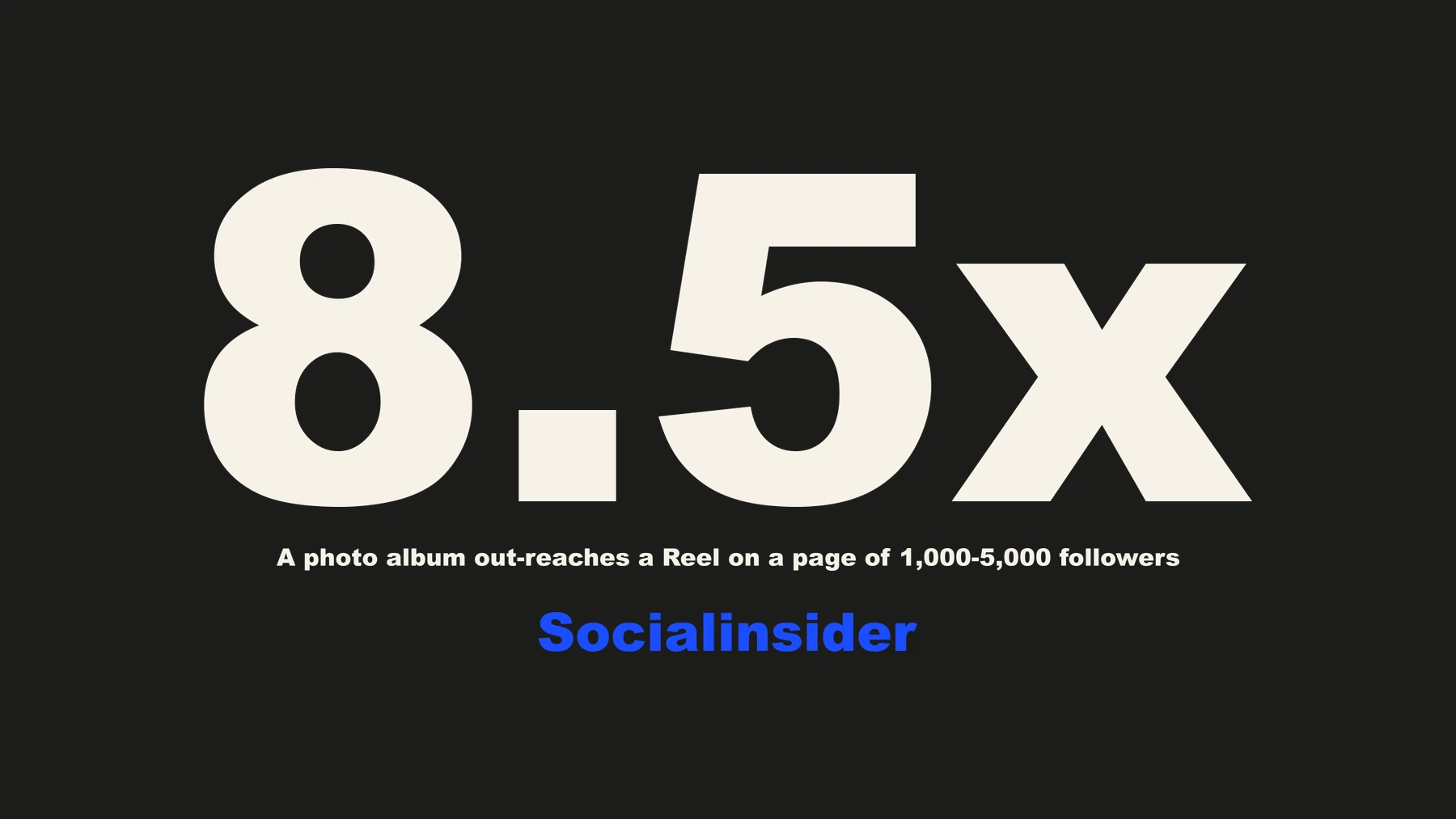
- 1,000–5,000 followers — album 85, image 60, status 60, link 20, Reel 10. Album beats Reel 8.5x.
- 5,000–10,000 — album 170, image 125, status 100, Reel 50, link 27. Album beats Reel 3.4x.
- 10,000–50,000 — album 300, image 270, status 215, Reel 100, link 47. Album beats Reel 3.0x.
- 50,000–100,000 — album 530, image 515, status 340, Reel 200, link 110. Album beats Reel 2.65x.
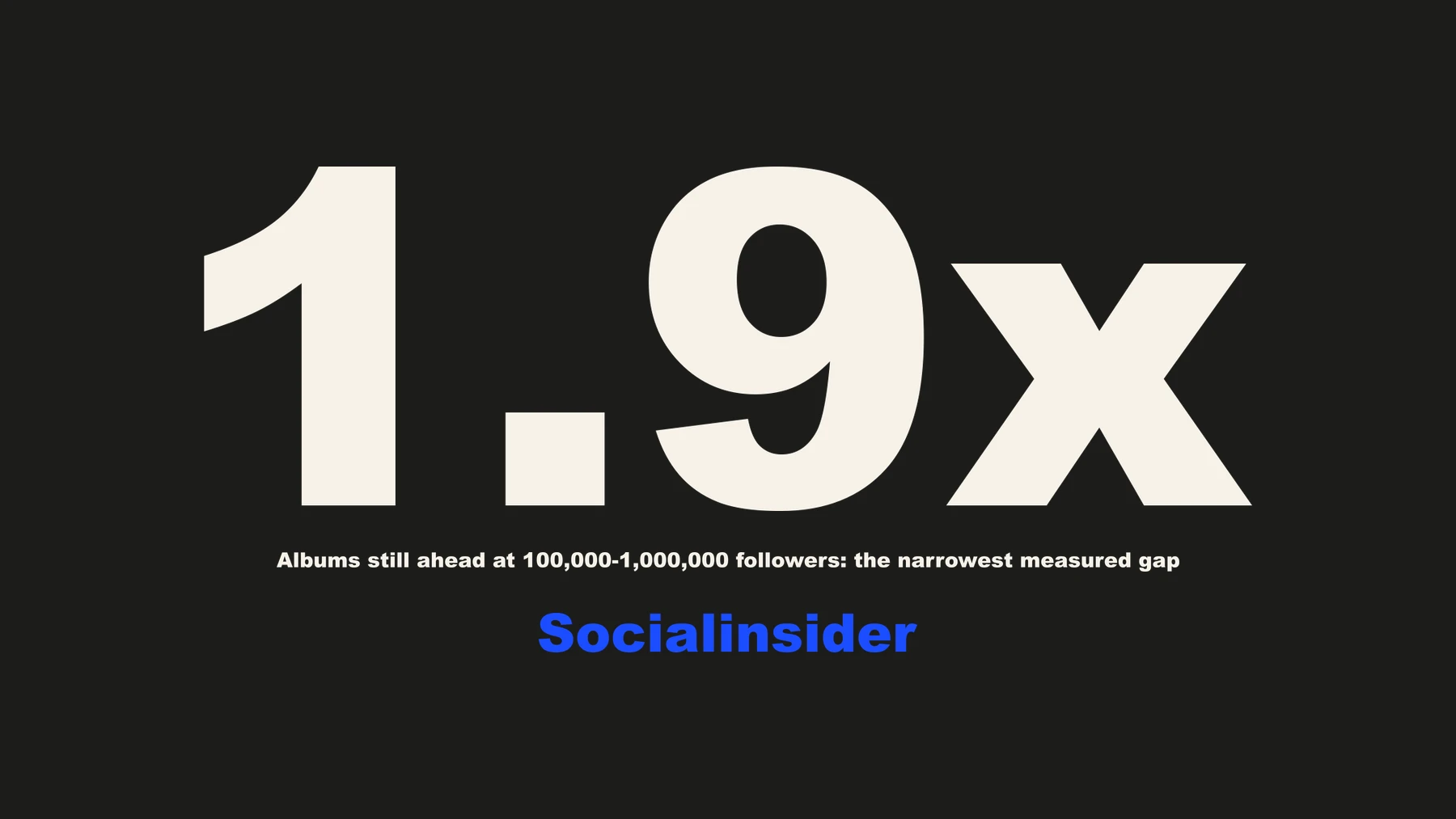
- 100,000–1,000,000 — album 1,150, image 1,125, status 820, Reel 620, link 200. Album beats Reel 1.9x.
A single-location jewelry store is almost always in the first band, sometimes the second. That is the 8.5x row.
One caveat on the metric, stated because the platform changed it: "views" approximates impressions since Meta unified its metrics in 2025. It is not deduplicated reach, and it is a mean rather than a median, which is outlier-sensitive on data as skewed as this.
Why a small page wins with photos and loses with Reels
The mechanism is not mysterious, and understanding it is more durable than memorising the multiplier — formats change, distribution logic changes more slowly.
Reels are distributed through an open recommendation pool. Your Reel is placed in front of people who do not follow you, where it competes against full-time professional creators with better equipment, better lighting and nothing else to do that day. A jewelry store in a town of forty thousand is entering a contest it is not equipped to win.
Photo posts are served primarily to the audience already connected to your page — the people who liked it, who bought from you, who live near enough to walk in. A small page wins on connected distribution and loses on recommended distribution. That is the whole finding in one sentence.
It also explains why the gap narrows as pages grow. A large page has enough connected audience that recommendation becomes the growth channel rather than the threat.
State this precisely, because it is usually stated backwards
Here is the part worth getting right, and the reason to be careful with anybody who repeats this finding to you.
You will see it reported as "albums win for small pages, Reels win for big ones." That is two separate datasets read as one study, and if you have a growing page the difference decides what you do next.
Inside the measured range above, albums lead in every single band — 8.5x at the bottom, still 1.9x at 100,000 to 1,000,000 followers. The gap narrows and never closes. Socialinsider's own careful word is that Reels become competitive above 100,000 followers. Competitive is not ahead.
The only evidence of an actual reversal comes from somewhere else entirely: a separate study of 147 large national brands across 257,854 non-promoted posts, where Reels averaged 41,000 organic reach against 35,000 for photos and 24,000 for carousels. [Measured] That population sits above the top of the table — national brands, not stores. Both datasets are sound. They describe different worlds, and splicing them produces a crossover that neither one shows.
So the honest statement is: albums out-reach Reels throughout the range a jewelry store will ever occupy, and the reversal that exists applies to brands several orders of magnitude larger than you.
The complication nobody mentions: reach is not engagement rate
This is where the argument gets less tidy, and leaving it out would be the same sin the rest of this article is about.
Everything above is about views — how many people see the post. On engagement rate, the picture is much closer and does not consistently favour albums. In the same source's full-year 2025 data, albums and Reels tie at 0.18% of followers; in its Q2 2026 quarterly data, Reels lead at 0.13% against albums at 0.11%. [Measured]
Two things follow.
Facebook has the narrowest format spread of any major platform — under one percentage point between the best and worst format on engagement rate. Format choice on Facebook is a smaller lever than on any other feed, which is worth knowing before anybody sells you a format strategy.
Reach and engagement rate answer different questions. Reach is how many people saw it; engagement rate is what share of your followers reacted. For a store whose problem is getting a person through the door — and across US independents unit sales fell 5.6% in 2025 while gross sales rose 4.7%, so it is — reach is the one that matters. Engagement rate on a post nobody saw is a percentage of nothing.
The finding that survives every source: stop posting links
Four independent datasets agree on this, which makes it the most robust thing in the whole format literature: link posts are the worst organic format on Facebook by a wide margin. [Measured]
Look back at the table. At 1,000–5,000 followers a link post gets 20 views against an album's 85. At 100,000–1,000,000 it is 200 against 1,150. It is beaten by every other format in every band, usually by three to six times.
If your process is "write something, then share the link on Facebook," that is the weakest available use of the platform, and it is what most stores do with their newsletter, their sale announcement and their blog. Put the content in the post itself.
What to actually do with this
- Post multi-photo albums, not single images and not Reels, while your page is under 10,000 followers. That is the 8.5x row, and it is the largest free lever in this article.
- Photograph your own inventory. Recycled and duplicated imagery is penalised on reach, and reposting the supplier's catalogue is the standard independent workflow — the same photo four hundred other stores also posted. [Measured] A mediocre photo of a ring on a real hand in your own light will out-reach it.
- Stop sharing links as posts. Put the words in the post and save the link for the comments or the profile.
- Revisit Reels above 100,000 followers, and not before. If you ever get there, they become competitive. They still do not overtake inside the measured data.
- Do not read this as "video does not work." It is a statement about Facebook, about small pages and about reach. A repair before-and-after is inherently a video, and it is the best content an independent jeweler can make.
What this article does not tell you
Three honest gaps, because the alternative is pretending:
- There is no jewelry-specific version of this table. These are cross-industry benchmarks. Nobody has published Facebook reach data segmented to independent jewelry retail, and anybody offering you a "jewelry industry benchmark" for this is almost certainly quoting an aggregation of aggregations. [Not measured]
- No published effect size exists for posting time, on any platform, from any vendor. The "golden hour" that underwrites the scheduling industry has never been measured by anyone. [Not measured]
- These figures are means on skewed data, and they are views rather than deduplicated reach. Treat the shape as solid and the decimal places as indicative.
The short version
For a Facebook page the size of an independent jewelry store's, a multi-photo album out-reaches a Reel by about eight and a half times, because Reels are distributed through an open recommendation pool where you compete with professional creators while photos are served to the audience you already have. Albums lead in every measured follower band and never lose one; the widely repeated claim that Reels overtake on larger pages comes from a different study of national brands and does not apply to any store. Engagement rate is close enough between formats to be a distraction, reach is the number that matters when traffic is the scarce input, and link posts are the worst format on the platform by every source that has looked.
Get this for your own store
Which of these matters most depends on who is actually within driving distance of your door — the ages, incomes and household mix of your trade area decide whether your Facebook audience is the 35-year-old buying for herself or the 68-year-old buying for his wife. That analysis, built from your own postal codes and the published Census figures for them, is free at myjewelrymarketing.com/demo/strategy.
Sources
Compiled by My Jewelry Marketing — myjewelrymarketing.com.
- Views by format and follower band, and engagement rate by format. Socialinsider's Facebook benchmarks, 2026. Note the publisher's own caveat: the dataset labelled "2026 benchmarks" is full-year 2025, because 2026 data was incomplete at publication; the quarterly figures are genuine 2026. Means rather than medians, and "views" approximates impressions rather than deduplicated reach following Meta's 2025 metric unification.
- The contradicting dataset. Dash Social, 147 large Facebook brands across 257,854 non-promoted posts — Reels averaging 41,000 organic reach against 35,000 for photos and 24,000 for carousels. A population above the top of the band table, and the only published evidence of a reversal.
- Link-post underperformance. Buffer, The State of Social Media Engagement in 2026 — 52 million posts across 200,000 accounts, January 2024 to December 2025 — agreeing with Socialinsider and two further datasets.
- Sales and unit trends at US independents. Edge Retail Academy point-of-sale data from approximately 2,000 US jewelry retailers, via INSTORE Magazine and National Jeweler.
- Posting time. No reliable source exists. Platform documentation, vendor research and academic databases were searched, and no vendor publishes an effect size.