For an independent jeweler, Black Friday is a positioning day, not a markdown day: 2025 sales rose 5.6% on price while pieces sold fell 5.2%.
Each figure below carries a label saying how much weight it can hold. [Measured] means point-of-sale or card data from a named source. [Survey] means a survey, with its sample size where one is published. [Trade] means consistent trade reporting without a measurement. [Not measured] means nobody has measured it.
One of a series at myjewelrymarketing.com checking which parts of the advice given to independent jewelers anybody has measured; the wider picture is in the state of independent jewelry retail in 2026, and the week-by-week season this post sits inside is in your holiday feed starts November 1.
Should an independent jewelry store discount for Black Friday?
The evidence says the case for it is weak. Independent jewelers' growth in 2025 came from customers spending more per piece, not from more customers, so a markdown spends margin on the one part of the business that was already working — while doing little for the part that was not.
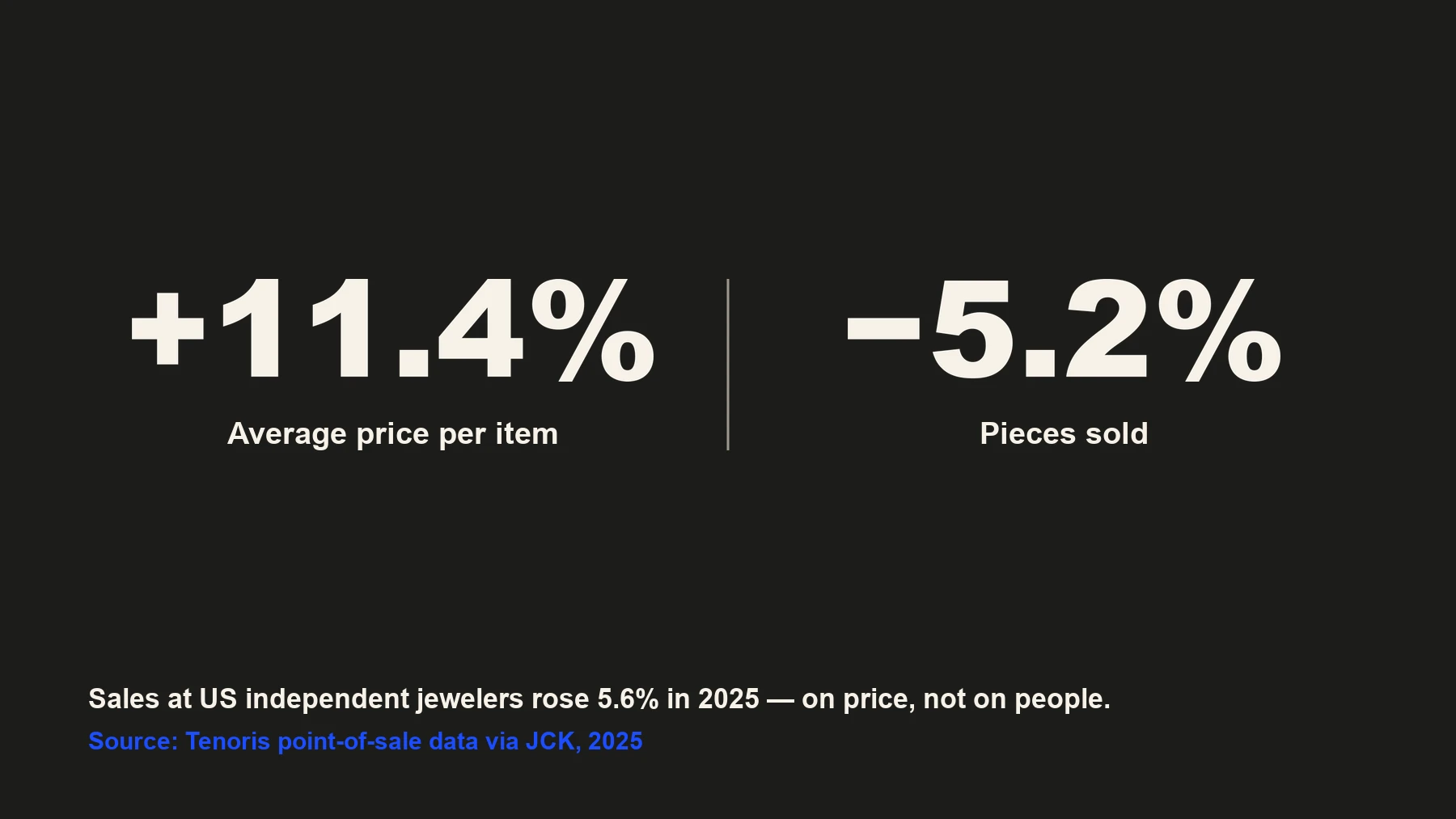
Across US independents in 2025, Tenoris point-of-sale data reported by JCK: [Measured]
- Sales rose 5.6%.
- The number of pieces sold fell 5.2%, with the drop concentrated in items under $2,500.
- The average price per item rose 11.4%.
The holiday weeks themselves followed the same pattern, only harder. In the same data, December sales rose 5.4% while units fell 10% and prices rose 17.2%. [Measured] Edge Retail Academy, which runs a separate point-of-sale panel, found the same direction in its own December: gross sales up 5%, driven largely by a 12% rise in average retail price, with diamond jewelry units down 13%. Its own summary was that record holiday sales in 2025 were "driven primarily by higher prices, not higher demand." [Measured]
Those are two different panels with different store counts, so we quote each one whole rather than mixing their figures. They agree on the point that matters: the holiday quarter was carried by ticket, and traffic fell.
The growth came from price, not from people
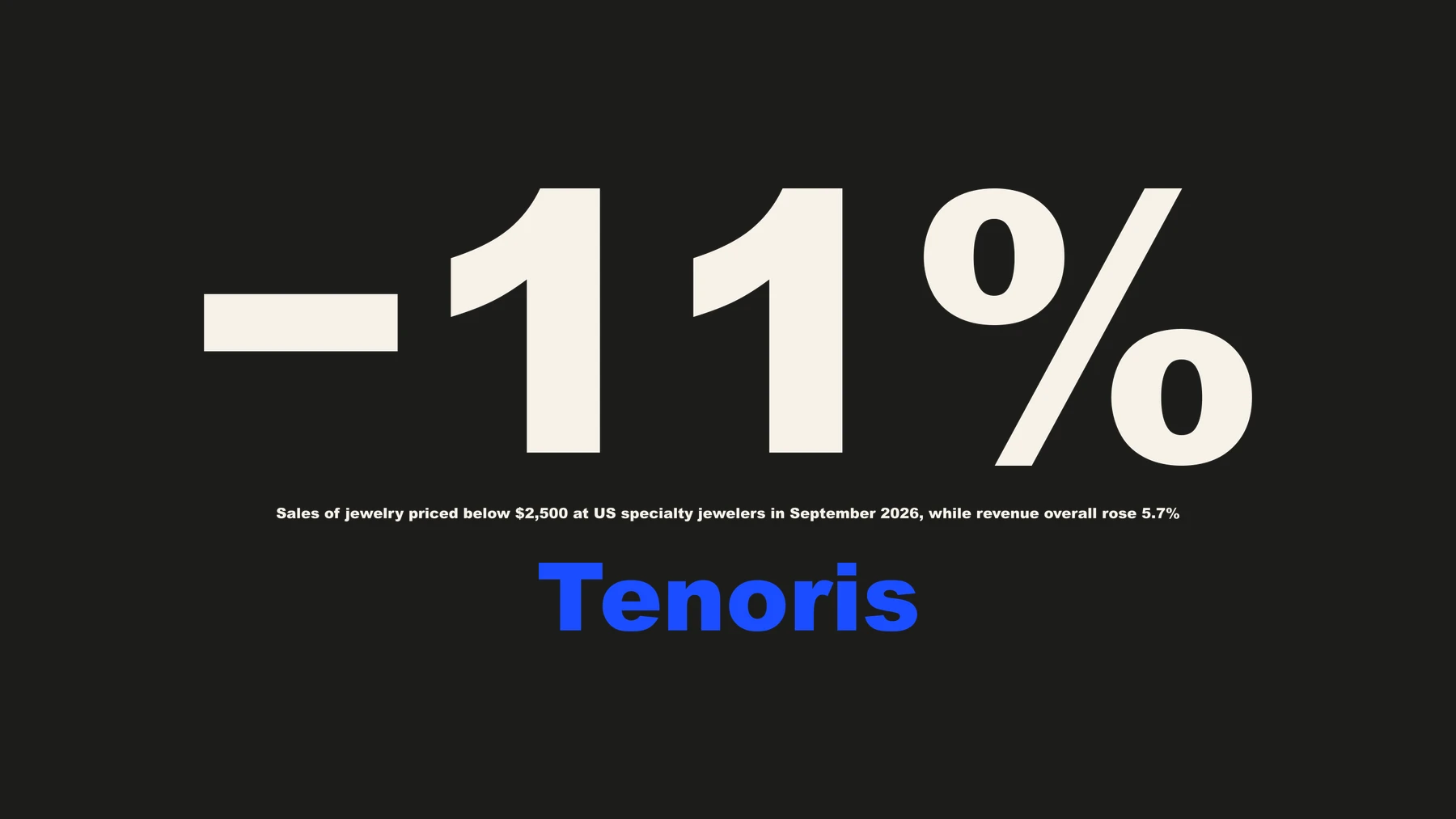
The pattern has not reversed in 2026. In September, revenue at US specialty jewelers rose 5.7% and average spending per item rose 11%, while sales of jewelry priced below $2,500 fell 11%. Year to date, revenue was up 8.5%. Tenoris calls it a market "increasingly divided by price point." [Measured]
Read that against the standard Black Friday plan — 20% off the case, or a doorbuster on studs — and the problem is plain. The customers who are still coming are spending more per piece without being asked to. The customers who have fallen away are the lower-priced ones, and a markdown on the same lower-priced pieces is competing for exactly the shopper the discount chains and the online marketplaces are built to win.
This is the pillar's finding in its seasonal form: traffic is the scarce input, not ticket, and a discount is mostly a ticket tool.
Black Friday still matters — for the people it brings out
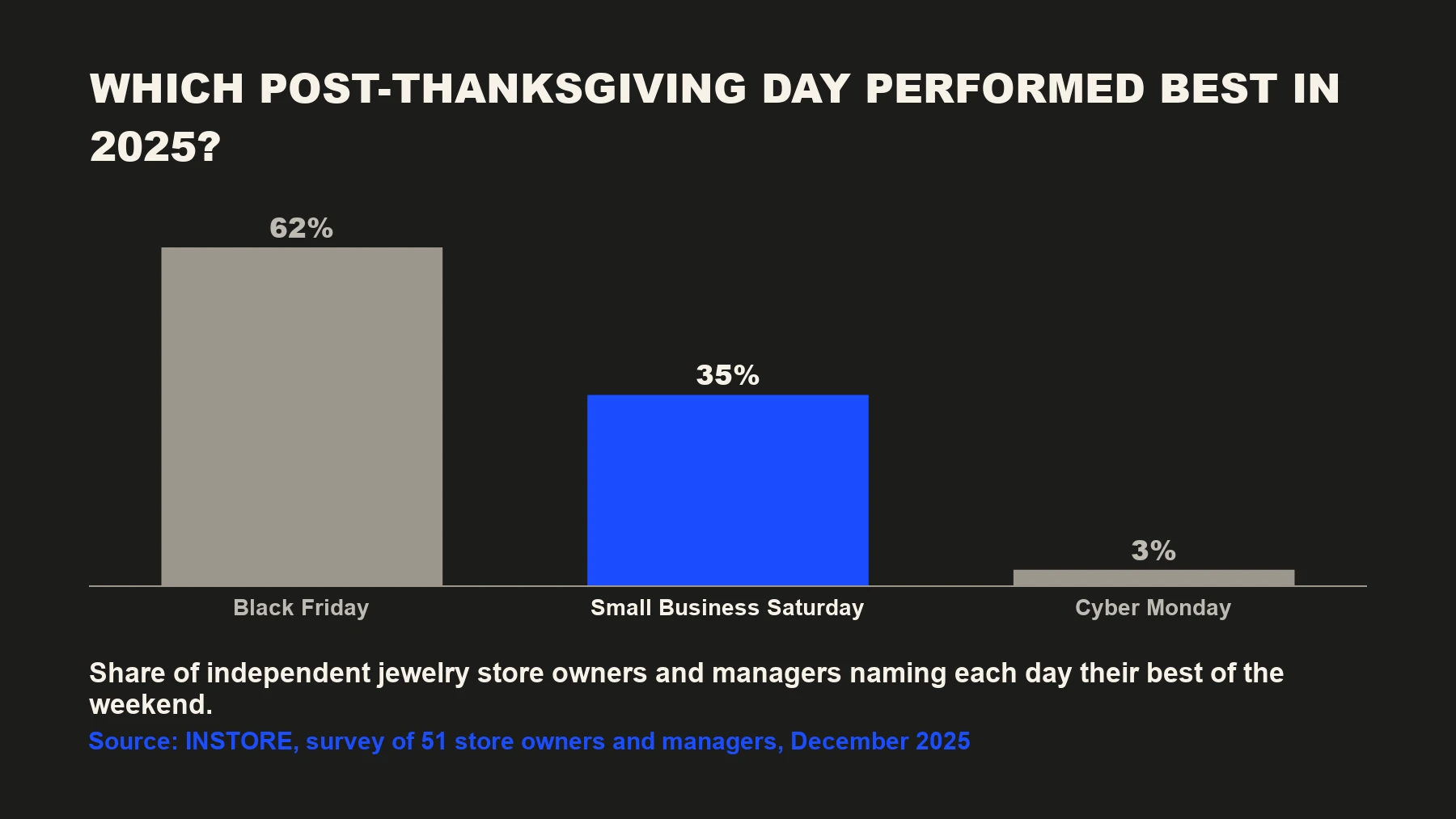
None of this means Black Friday is a quiet day for an independent. When INSTORE asked jewelry store owners and managers which of the three post-Thanksgiving days performed best in 2025, 62% said Black Friday, 35% said Small Business Saturday and 3% said Cyber Monday. More than half, 51%, reported a higher average ticket than the year before. [Survey — n=51]
Card data points the same way and adds a caution. Mastercard SpendingPulse measured US jewelry sales on Black Friday 2025 up 2.75% on the year, against 4.1% for retail overall excluding autos. [Measured] That figure covers every channel, including discounters, and is not adjusted for inflation — so in a year of record gold prices it says more about price than about how many pieces changed hands.
So the day brings people out. The question is what they find when they get to you, and whether it is a reason to come back in December.
What a markdown actually buys
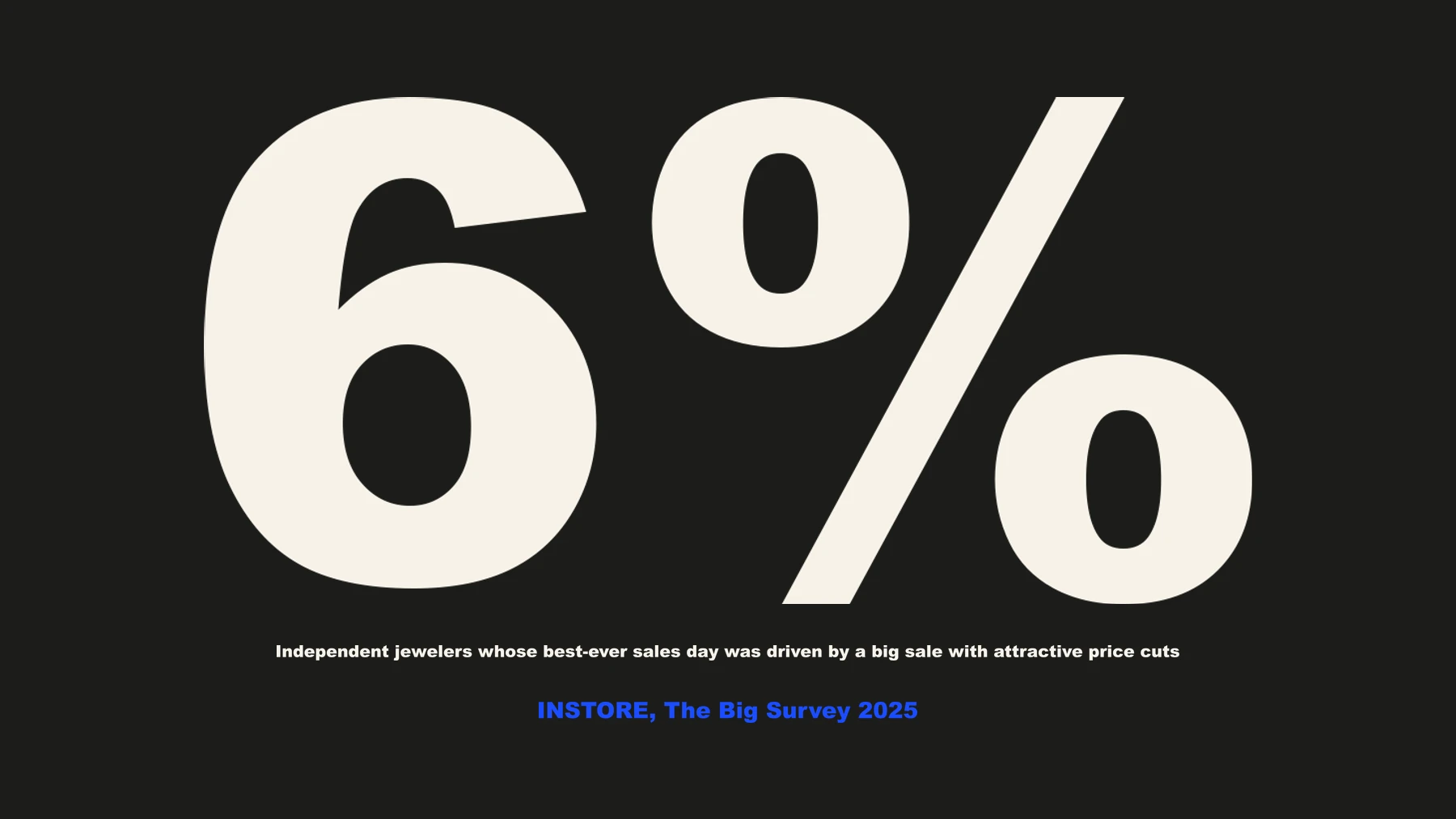
When INSTORE asked jewelers what produced their highest-sales day ever, 6% said a big sale with attractive price cuts. One customer who spent a small fortune was the most common answer at 35%; a regular holiday-season day that went unexpectedly well was 19%; a special event such as a ladies' night or a roundtable was 12%. [Survey — sample size not disclosed by the publisher]
The same survey asked how much of the year the holiday season carries. For independents it is less concentrated than the national headlines suggest: the largest group, 41%, said Black Friday to New Year's Eve was 20–29% of their annual sales, and only 8% put it at 40% or more. [Survey — sample size not disclosed] A store whose season is a quarter of its year does not need to buy one weekend at any price.
What nobody has measured is the thing a store would most like to know: whether a Black Friday discount at an independent jeweler adds to the season's profit or simply moves December's sales forward at a lower margin. No published study answers it, for jewelry or for small retailers generally. [Not measured] Anyone quoting you a return on a doorbuster is guessing.
What positioning looks like on Black Friday weekend
Positioning means giving the people who come out a reason to choose you that a chain cannot copy by cutting a price. For an independent, those reasons are already in the building. In order of how directly they answer the data above:
- The pieces nobody else has. Independents' colour, custom, remake and one-of-a-kind categories have been growing by double digits, as the pillar sets out, and they cannot be price-matched because nobody else sells them. [Measured] Lead the weekend's posts with them.
- Service, made visible. Free cleaning and inspection while they shop, sizing done on the spot, engraving booked for collection. It is the reason to come in that has nothing to do with price, and it puts customers' own pieces on your counter.
- The custom deadline. The last date to start a custom piece for Christmas is real news on Black Friday, and it is the opposite of a discount: it tells people your work takes time.
- Wish lists and appointments. A wish list written on Friday is a December sale to whoever reads it. Appointment booking tells the person who hates crowds there is a better time to come.
- Your prices, stated without apology. Customers absorbed an 11.4% rise in average price last year. A post that leads with "only" or "just" undoes a number the market has already accepted.
If you want an offer on the weekend, make it one that adds rather than subtracts — a gift with purchase, complimentary engraving, a gift card bonus for December — and say why. That is a convention rather than a measured improvement on a markdown, and we label it that way. [Trade]
What to post, Thursday to Monday
The weekend's feed is short and specific. [Trade]
- Thanksgiving — nothing, or a plain thank-you. Nobody is shopping your feed.
- Black Friday morning — a multi-photo album of the pieces nobody else has, with prices in the post and your hours in the first line. Albums out-reach every other format to your own followers on a page your size; the table is in why photo albums beat Reels for small jewelry pages. [Measured]
- Black Friday, during the day — one short Reel from the floor, posted the day it happens and opened with your voice; the measured spec is in the holiday Reels post.
- Saturday — Small Business Saturday is the day built for a store like yours, and the run-up to it starts in mid-November, as the holiday plan lays out.
- Cyber Monday — at 3%, it does not need a campaign. A gift-card post for the people who will not make it in is enough.
And no share-to-win "Black Friday giveaway" — those mechanics break two Facebook rules at once.
What this article does not tell you
- Whether discounting pays at your store. Not measured anywhere; your own point-of-sale history from past years is the only evidence that applies to you. [Not measured]
- What your trade area will do. The Tenoris and Edge panels are national. A store in a falling-income postal code and one in a rising one face different weekends.
- The 62% is a small survey. Fifty-one stores is a direction, not a benchmark.
What does this mean for the independent jeweler?
It means the Black Friday markdown most stores run out of habit is aimed at the wrong problem. The customers still coming in spent more per piece last year without being asked to. What fell was the number of people, and the pieces that stopped selling were the lower-priced ones — exactly the shopper a discount war is fought over and exactly the war a chain or a marketplace is built to win.
It also means you do not have to sit the weekend out. Black Friday was the best of the three days for most of the jewelers who answered, so people do come. With a small staff on the busiest morning of the year, the useful question is not how much to take off but what those people see when they walk in — and nobody has measured whether a markdown pays an independent back, so it is not worth spending margin to find out.
What's the solution?
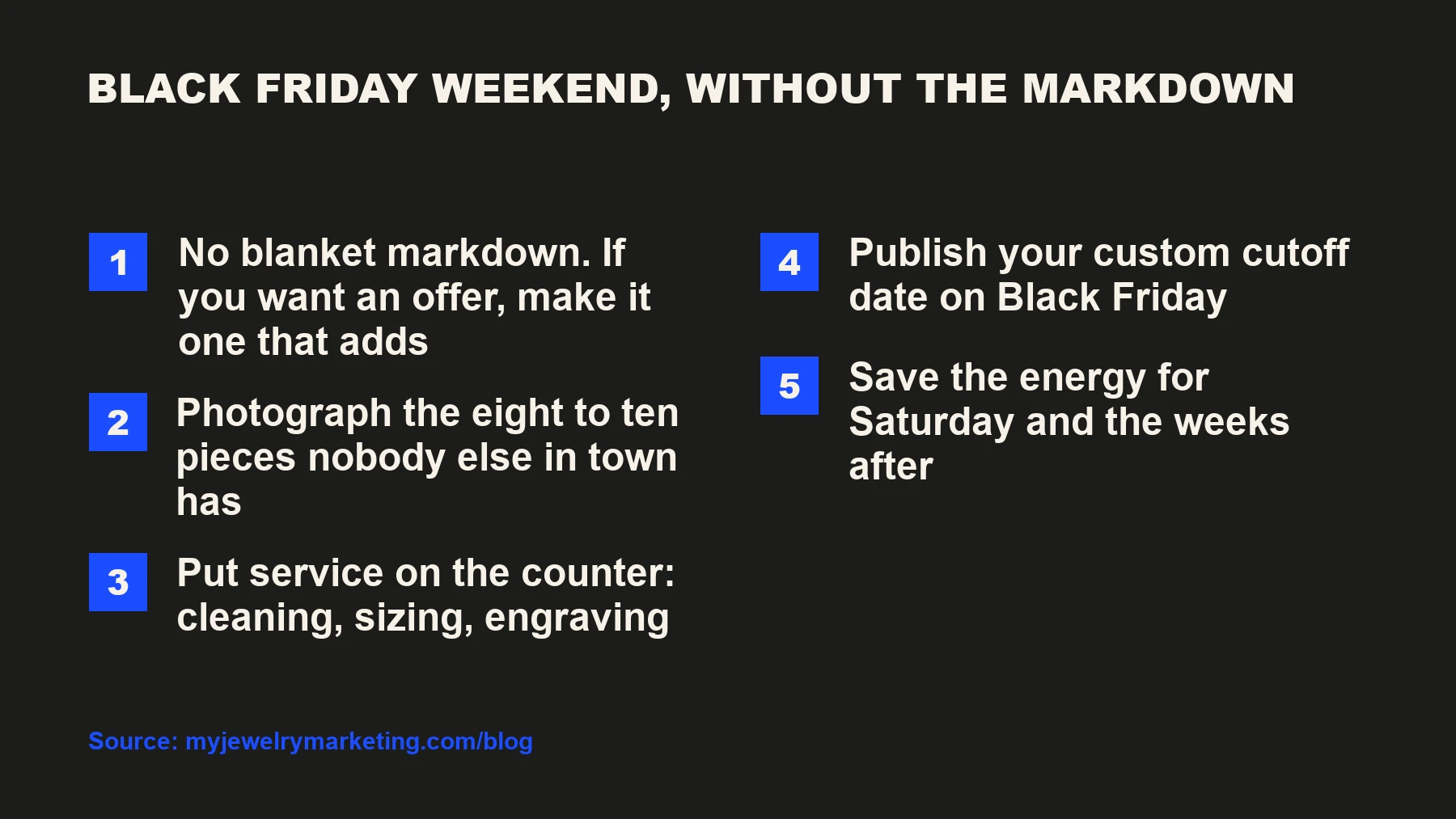
Five things a store can do this month without help:
- Decide now that the weekend has no blanket markdown. If you want an offer, make it one that adds — engraving, a gift with purchase, a December gift-card bonus.
- Pick the eight to ten pieces nobody else in town has and photograph them yourself, on a hand, in your own light. That is Black Friday morning's album.
- Put service on the counter: free cleaning and inspection all weekend, sizing on the spot, engraving booked for collection.
- Publish your custom cutoff date on Black Friday, with wish lists and appointment booking alongside it.
- Save the energy for Saturday and the weeks after. Small Business Saturday is the day built for you, and December is the month that carries the season.
This is how My Jewelry Marketing plans the weekend for the stores we work with: the posts lead with the pieces and the service a chain cannot copy, the album and the Reel are made in advance from the store's own stock, and nothing in the feed asks a customer to wait for a discount. The research behind that approach is at myjewelrymarketing.com.
The short version
Independent jewelry grew in 2025 because customers paid more per piece, not because more of them came in: sales rose 5.6% while pieces sold fell 5.2% and the average price per item rose 11.4%, and December ran the same way harder. The pattern held into September 2026, with sales of jewelry under $2,500 down 11%. A Black Friday markdown spends margin on the ticket, which was already working, and competes for the lower-priced shopper the chains are built to win. Black Friday still brings people out — 62% of surveyed jewelers named it their best day of the weekend — so make it a day of positioning: the pieces nobody else has, service on the counter, the custom deadline, and prices stated plainly. Only 6% of jewelers say their best-ever day came from a big sale, and nobody has measured whether a discount pays an independent back.
Get this for your own store
Every figure above is national, and the weekend that suits you depends on who lives within driving distance of your door. The free strategy at myjewelrymarketing.com/demo/strategy builds your season from the published Census figures for your own postal codes. Paste your website address and read it in a couple of minutes.
Sources
Compiled by My Jewelry Marketing — myjewelrymarketing.com.
- 2025 sales, units and average price at independents, and December 2025. Rob Bates, "Mom-and-Pop Jewelers Enjoyed a (Mostly) Strong 2025," JCK, 9 January 2026 — Tenoris point-of-sale data: sales +5.6%, units −5.2% (concentrated under $2,500), average price per item +11.4%; December sales +5.4%, units −10%, prices +17.2%.
- December 2025, second panel. Edge Retail Academy, "December 2025 Jewelry Retailer Statistics," 2 January 2026 — gross sales +5%, average retail price +12%, diamond units −13%.
- September 2026. Tenoris, "Upward Trend Continues in September 2026," 7 October 2026 — specialty-jeweler revenue +5.7%, average spending per item +11%, jewelry under $2,500 −11%, year to date +8.5%.
- Best day of the weekend. INSTORE, "Indie Jewelers Report Solid Black Friday, Raising Hopes for 2025 Holiday Season," 3 December 2025 — 51 store owners or managers, responses collected 2–3 December 2025.
- Black Friday card spending. Mastercard SpendingPulse, "U.S. Black Friday retail sales up +4.1% year over year," 29 November 2025 — jewelry +2.75%; all channels and payment types, not adjusted for inflation.
- Best-ever sales day and holiday share of the year. INSTORE, "The Big Survey 2025: Performance," 5 November 2025 — the publisher does not disclose a sample size.
- December's share of the year. US Census Bureau, Retail Sales: Jewelry Stores, via FRED — 2019 structural baseline, laid out in the real marketing calendar.
- Whether a Black Friday discount pays an independent jeweler. No reliable source exists.