No jewelry store event format has a published attendance or revenue figure, and lead time decides the calendar: the big November events were booked by July.
Each figure below carries a label saying how much weight it can hold. [Trade] means consistent trade-press reporting or named practitioners — what stores do, not a measurement of what it earns. [Survey] means a survey. [Not measured] means nobody has measured it.
One of a series at myjewelrymarketing.com checking which parts of the advice given to independent jewelers anybody has measured; the wider picture is in the state of independent jewelry retail in 2026.
Every "event ideas" list is missing the same two things
Search jewelry store event ideas and you will find no shortage of lists. What none of them prints is a result, or a start date — and the second omission is the one that quietly wrecks calendars.
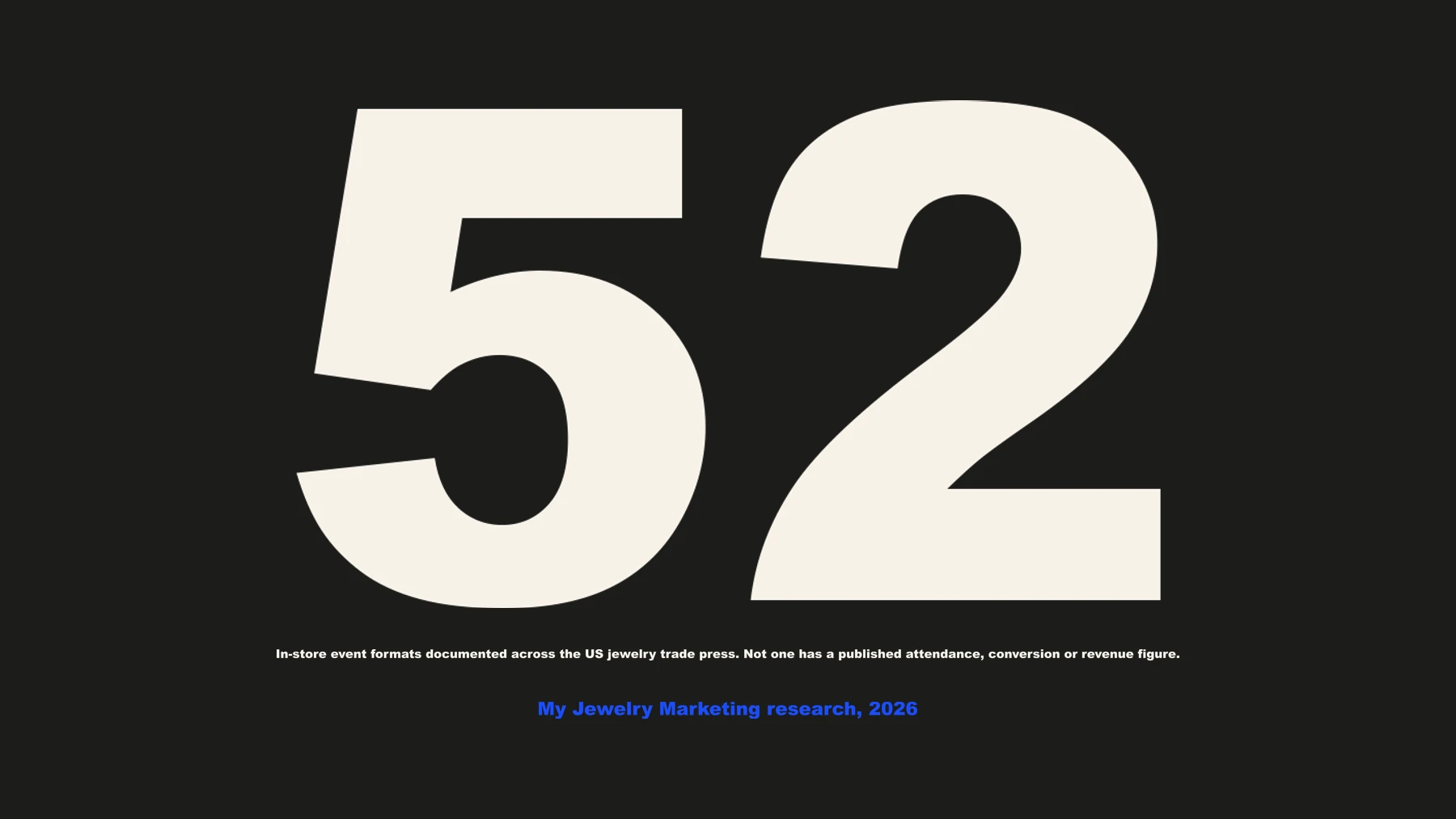
We compiled fifty-two in-store formats from the US jewelry trade press — National Jeweler, INSTORE, Southern Jewelry News, Jewelers Mutual, and named practitioners — with, for each one, the months it suits, the effort it takes, and the lead time it needs. [Trade] This article is the honest version of that list: what is documented, what is not, and what an October reader can still actually book.
Nobody has published what any of these earn
This deserves to be said plainly, because it is the part every list omits: no attendance figure, conversion rate or revenue number is published for any in-store jewelry event format. [Not measured]
What exists instead is anecdote. Several trade articles quote one store's result from one event — a real number, from a real store, that becomes a forecast the moment it is reprinted beside a format you have not run. And some suppliers publish per-event revenue ranges for formats they sell into — permanent-jewelry welding is the current example — which are self-reported, measured on standalone operators rather than jewelry retailers, and not reprinted here for exactly that reason.
The closest thing to a directional finding comes from a practitioner: Garris Jewelers, interviewed by Clientbook, reports that their best-attended events are community-driven rather than promotional — the fundraiser outdraws the sale. [Trade] One store's experience, labelled as such.
None of this means events do not work. It means the case for them rests on what they visibly do — put people in the store on a day they had no other reason to visit — and not on a benchmark. Anyone selling you an events program with projected revenue attached is quoting a number that does not exist.
The six kinds of event, and what each is for
Every format in the fifty-two falls into one of six categories, and naming them is useful because a balanced year draws from several rather than repeating one:
- Vendor and product — someone else's inventory or expertise in your store for a day. The designer trunk show is the archetype.
- Service and utility — a reason to walk in that costs the customer nothing: cleaning and inspection day, watch battery day, appraisal day.
- Experience and hands-on — the customer makes or gets something on the spot: permanent jewelry, a stacking-ring bar, a ring-making workshop.
- For one audience — a night built for a group rather than for everyone: ladies' night, bridal party night, a teachers-and-nurses evening.
- Community and partnership — the store as a neighbour: a percentage-of-sales night, a street crawl, Small Business Saturday.
- Loyalty — for the people already on your list: a VIP preview, a customer appreciation open house, the store anniversary.
The service category is the one most stores under-use, and it is the cheapest: a cleaning-and-inspection day is one person, a sign and a post, decidable this week. [Trade]
Lead time is the whole game
The formats are not interchangeable on the calendar, because their lead times run from one week to four months.
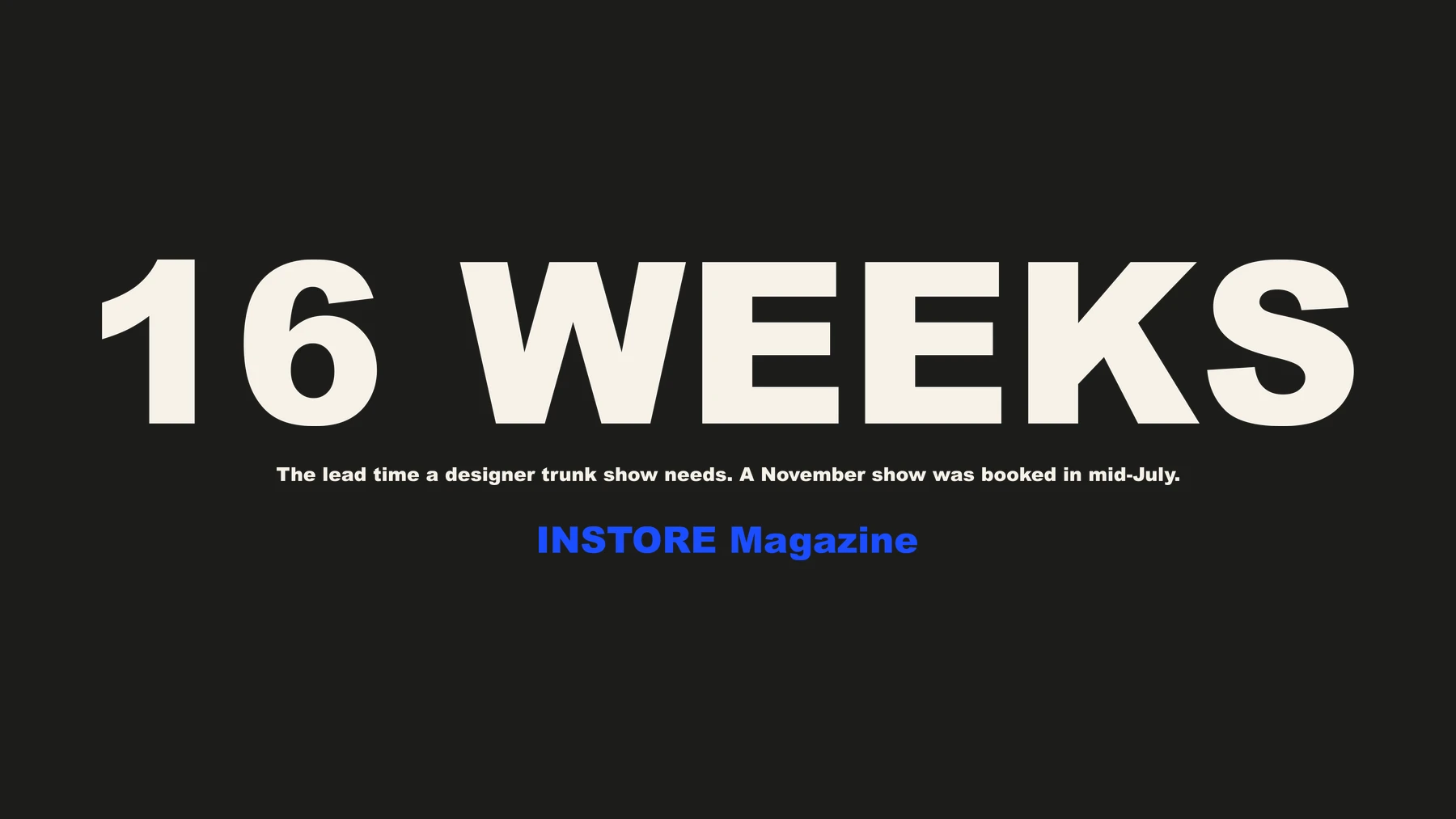
A designer trunk show needs about sixteen weeks: the vendor is booked roughly four months out, similar vendors must not share a weekend, and the client list is invited three to four weeks ahead. [Trade] Which means the November trunk show in this article's title was booked in mid-July — and a store deciding in October that it wants one has already missed this season. A bridal trunk show runs about fourteen weeks for the same reason.
At the other end, a watch-battery day or a metal-stamping night needs two weeks, and a birthstone-of-the-month table needs one. The spread is the planning insight: an event calendar is built backwards from lead times, not forwards from occasions. The same mistake we documented for content — starting engagement content in November, holiday content in December — has an events version, and it costs more per instance because an event has a vendor, a room and a date.
What an October reader can still book for the holidays
Being honest about arrival time, as this series tries to be: if you are reading this in early October, the sixteen-week formats are gone for this season. Put the trunk show in next June's diary. What is still genuinely bookable, by lead time from early October: [Trade]
- A Small Business Saturday hunt — five weeks, and Small Business Saturday is the strongest local retail hook of the year.
- A wish list night — six weeks. Partners come in December and buy what was written down in November.
- A gentlemen's night — six weeks, aimed at December's biggest buying group.
- A customer appreciation open house — five weeks, and the trade's most consistently reported holiday format.
- A charm bar or engraving day — three weeks each, both naturally giftable.
- A free cleaning and inspection day, or a metal-stamping night — two weeks each. The cleaning day also fills the case with pieces to photograph.
Each of those is low or medium effort. What they have in common is that none requires an outside vendor contract, which is where the long lead times come from.
January is an events month, and almost nobody treats it that way
January is the year's weakest sales month — it indexes at 66 against an average month of 100, a fact we covered in the real marketing calendar — and that is precisely why it suits events. The floor is quiet, the bench has capacity, and the month's natural traffic is just-engaged couples from December, the year's most popular month to propose.
The formats that fit it are almost all service formats with short leads, bookable in December: an appraisal day, a repair walk-in clinic, an insurance documentation day, a redesign-your-old-gold week, a loose diamond viewing for the newly engaged. [Trade] None needs a vendor. All of them give a January visitor a reason to walk in during the month the store most needs one — and repair customers, as we covered in the repair post, visit twice per job.
What this article does not tell you
- Whether any of this converts. No format has a measured attendance or revenue benchmark, and we have not invented one. [Not measured]
- Which format fits your store. That depends on your trade area — a trunk show wants a catchment with income room above the median; a graduation evening wants families. National trade reporting cannot see your postal codes.
- Fee and capacity conventions. Agency and vendor content publishes some (workshop sizes, charge-versus-free conventions); we treat those as conventions, not measurements.
Three event formats chosen for your own trade area and the current month — with the timing and the posts to go with them — are part of the free strategy at myjewelrymarketing.com/demo/strategy.
What does this mean for the independent jeweler?
It means the question to ask about an event is not "what is the best event?" but "what can we still start in time?" A store run by a handful of people tends to decide on an event when the occasion is close. By then the sixteen-week formats are gone and only the two-week ones are left. That is not a disaster, because the short-lead service formats are the cheapest ones and nobody has shown that the expensive ones earn more. But it does mean the year's calendar is set by accident rather than by choice.
It also means that when someone quotes you an event's expected revenue, you should treat it as the one number in the conversation that nobody has measured. The honest case for an event is simpler and still strong: it gives people who had no other reason to come in on that day a reason to do it.
What's the solution?
Plan events backwards from their lead times, and start with the formats you can run on your own:
- Pick next year's big vendor event now, and book it sixteen weeks out. For a November trunk show, that means a note in the diary for mid-July.
- Run one service event a quarter. A cleaning-and-inspection day, a watch-battery day or an appraisal day needs one person, a sign and a post, and about two weeks' notice.
- Put January events on the calendar in December. Appraisals, repairs, insurance documentation and redesigning old gold, aimed at the newly engaged and the post-holiday breakage.
- Lean toward community over promotion. It is one practitioner's report, not a measurement, but it costs nothing to try: a fundraiser night before another sale.
- Write down what happened. Headcount, sales on the day, and what you would change. Nobody publishes these numbers, so your own are the only ones you will have.
This is how events work in the plans My Jewelry Marketing builds. Each month's plan suggests three formats whose preparation starts that month, chosen for the store's trade area, with the invitation and the posts already written. We then make and publish those posts on the timetable the lead time sets, so the announcement goes out when people can still plan to come.
The short version
Fifty-two in-store event formats are documented across the US jewelry trade press, and not one has a published attendance, conversion or revenue figure — the case for events is what they visibly do, not a benchmark, and anyone attaching projected revenue to an events program is quoting a number that does not exist. What actually decides an event calendar is lead time: a designer trunk show needs about sixteen weeks, so November's was booked in July, while a cleaning day needs two and a birthstone table one. An October reader can still book Small Business Saturday, a wish list night, a gentlemen's night, an open house or a charm bar for this season — and January, the year's quietest month, is the natural home for the service formats that give the newly engaged a reason to walk in.
Get this for your own store
The fifty-two formats are national; which three suit your store this month depends on your calendar and on who lives within driving distance. The free strategy at myjewelrymarketing.com/demo/strategy picks them for your own trade area from your postal codes' published Census figures, alongside the rest of your Facebook plan. Paste your website address and read it in a couple of minutes.
Sources
Compiled by My Jewelry Marketing — myjewelrymarketing.com.
- The fifty-two formats, their categories, months, efforts and lead times. My Jewelry Marketing's own 2026 events research, compiled from the US jewelry trade press; every format is trade-tier — reported practice, not measurement — and the compilation deliberately attaches no expected result to any of them.
- Trunk show planning and lead times. INSTORE Magazine, "10 Tips For Trunk Show Success" — book roughly four months ahead, invite the list three to four weeks out, never two similar vendors on one weekend. Jewelers Mutual, on what distinguishes a trunk show.
- Holiday event formats. National Jeweler, "Creative Connecting: Fun Ideas for Holiday In-Store Events", November 2022 — themed parties, treasure-key mailers, ladies' and gentlemen's nights, permanent-jewelry and piercing parties, from a marketing consultant and named retailers.
- The community-over-promotional observation. Clientbook, "The dos and don'ts of in-store events, featuring Garris Jewelers" — one practitioner's reported experience, labelled as such.
- Monthly sales index. US Census Bureau retail series for jewelry stores, 2019 structural baseline — the arithmetic and its limitation are laid out in the real marketing calendar.
- Event results. No reliable source exists. No format has a published attendance, conversion or revenue benchmark; supplier self-reported revenue ranges exist for some formats and are excluded here because they are not measurements on jewelry retailers.