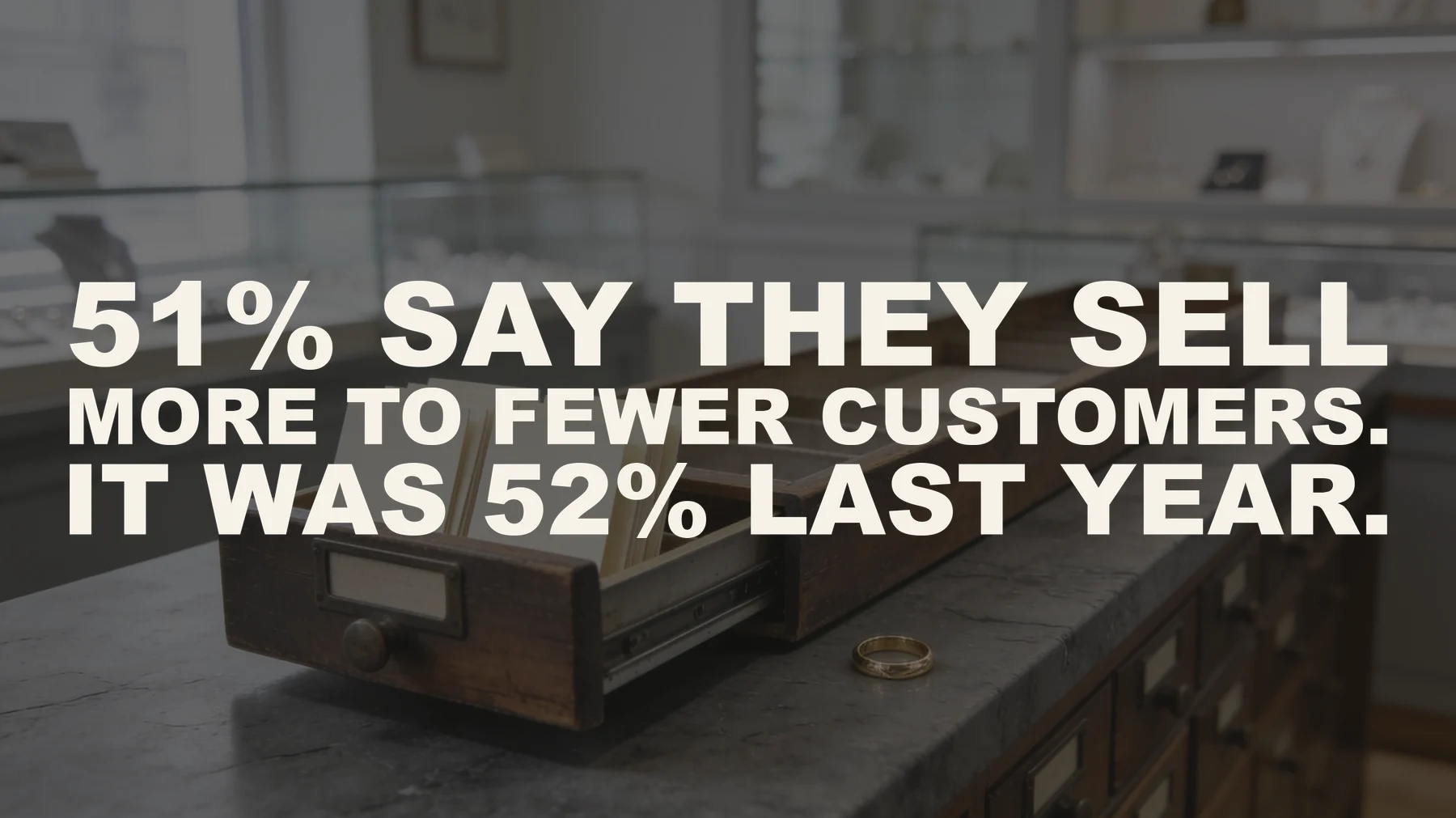
51% of independent jewelers say they sell more to fewer, wealthier customers, against 52% in 2025; the belief is common but it did not grow this year.
Each figure below carries a label saying how much weight it can hold. [Measured] means a named dataset with a real sample stands behind it. [Survey] means a survey, with its sample size where one is published. [Practitioner] means one store's account, or trade opinion nobody has measured. [Not measured] means nobody has measured it. Anything marked [Our arithmetic] is a calculation in this article, not a finding from a source.
One of a series at myjewelrymarketing.com checking which parts of the advice given to independent jewelers anybody has measured; the wider picture is in the state of independent jewelry retail in 2026.
Are jewelers really selling to fewer customers?
About half believe so, and that share has not moved in a year. In the 2026 Big Survey, 45% said their sales had become moderately more concentrated and 6% dramatically so. In 2025 those answers were 46% and 6%. 51% say they sell more to fewer customers. It was 52% last year. [Survey — more than 500 owners and managers in 2026, 631 responses in 2025; self-selected readers]
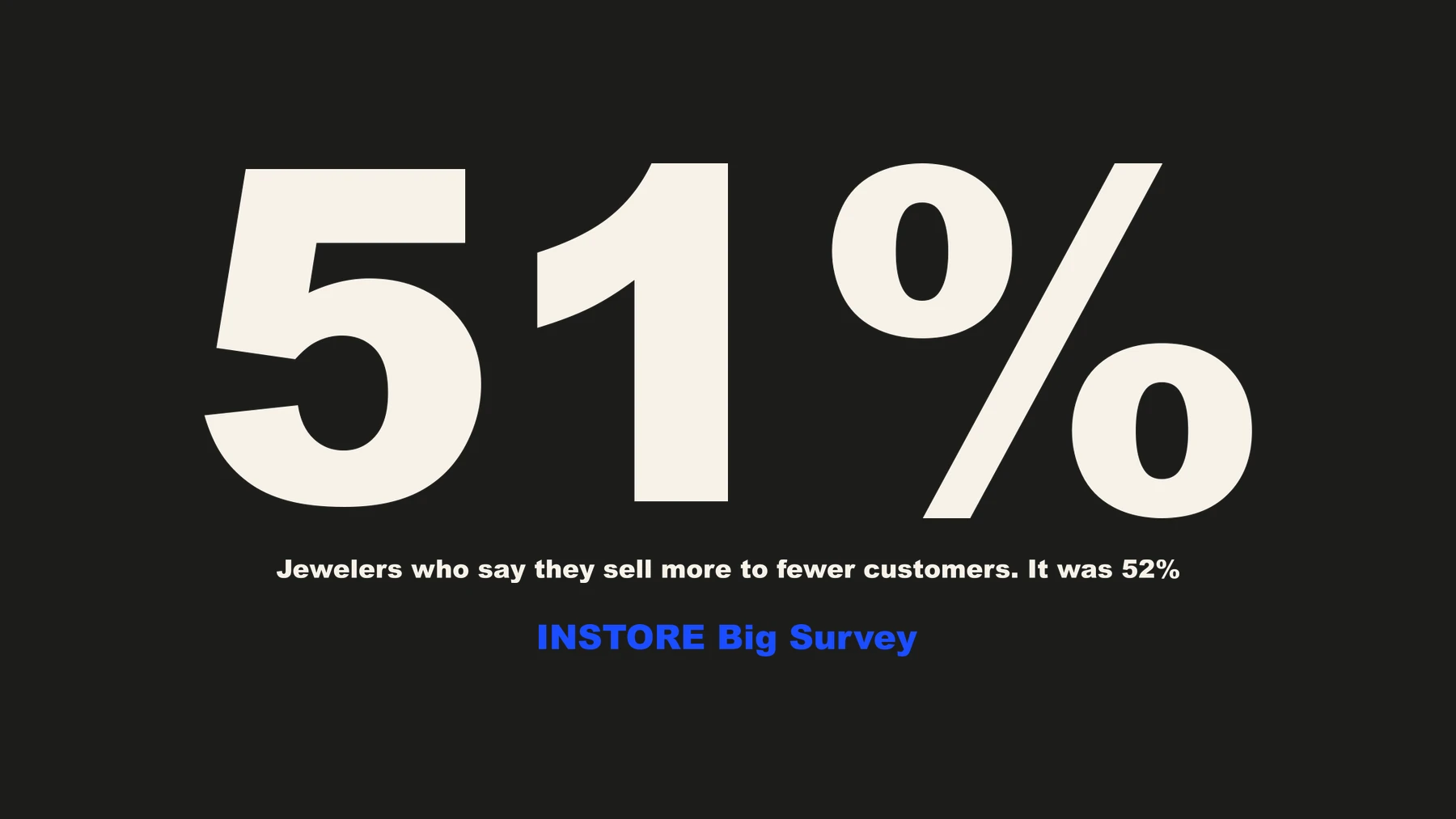
A one-point move between two surveys of different people is no move at all. What did move sits underneath it:
- "No change" rose from 27% to 35%. [Survey]
- Making more smaller sales to a larger pool of customers fell from 18% to 12%. [Survey]
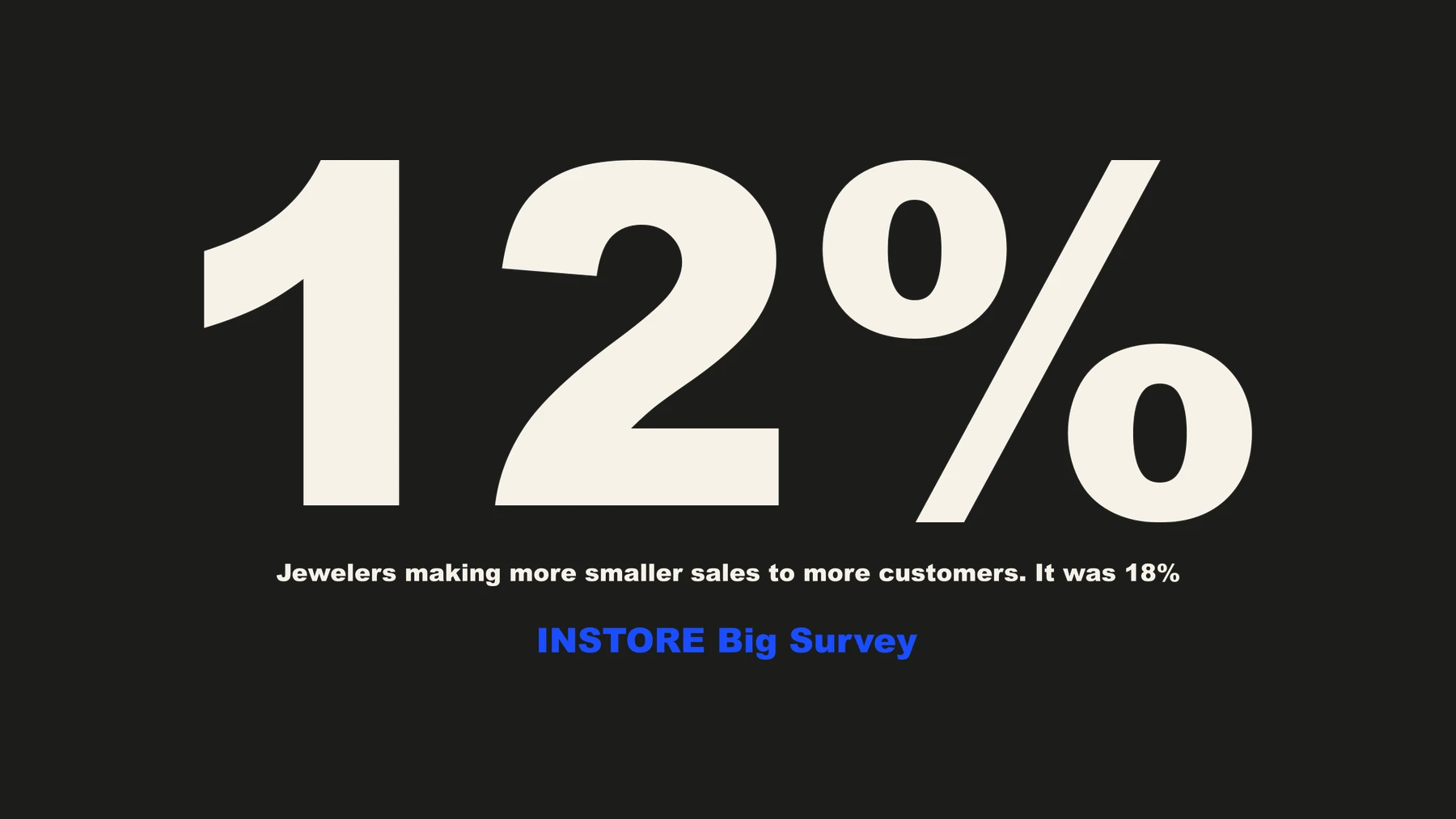
That second line is the one to watch. Fewer stores report a broad, growing customer base, but the answer that gained ground is "no change", not "more concentrated". These are two different groups of respondents, so read it as a direction and not a measurement.
These are owners' impressions, not till records. We found no published point-of-sale measure of how concentrated customers are at independent jewelers. [Not measured]
How much do a jeweler's best customers really spend?
For most stores, the top 5% of customers bring in about 20–30% of sales, and fewer stores than last year put it higher. These are the 2026 estimates, with 2025 in brackets: [Survey]
- Around 10%: 16% of stores (15%)
- Around 20%: 39% (27%)
- Around 30%: 19% (19%)
- 40% or more: 20% (26%) [Our arithmetic — bands added together]
- Don't know: 7% (12%)
Add the top bands and 39% of stores put their top 5% at 30% of sales or more, down from 45%. [Our arithmetic] INSTORE's own 2025 commentary called the trend more prominent. The two years side by side do not show that. They show the estimates settling toward 20%, and more owners being able to answer at all.
Here is what the most common answer means in dollars, on invented round numbers. A store selling $1 million a year to 1,000 customers has 50 people in its top 5%. At 20% of sales, those 50 spend $200,000 between them, or $4,000 each. Lose five of them and $20,000 walks with them. [Our arithmetic — illustrative]
What are customers asking for in 2026?
Lab-grown first, and estate second, well ahead of natural diamonds. Asked what they were seeing more customer interest in this year, jewelers could name several categories: [Survey — more than 500 stores]
- Lab-grown diamonds: 53%
- Antique, estate or pre-owned: 37%
- Exceptional colored gemstones: 25%
- Substantial gold jewelry: 24%
- Natural diamonds: 23%
- Important or statement diamonds: 22%
- Accessible, entry-price pieces: 17%
This measures interest as owners see it, not sales. Asked about the next breakout trend, many jewelers expected ways around the gold price: silver, gold-filled, low-karat and two-tone. About one in five admitted having no idea, which is worth remembering next time somebody sounds certain. [Survey] How lab-grown has split into separate markets is in lab-grown isn't one trend anymore.
How much of a jeweler's stock is over a year old?
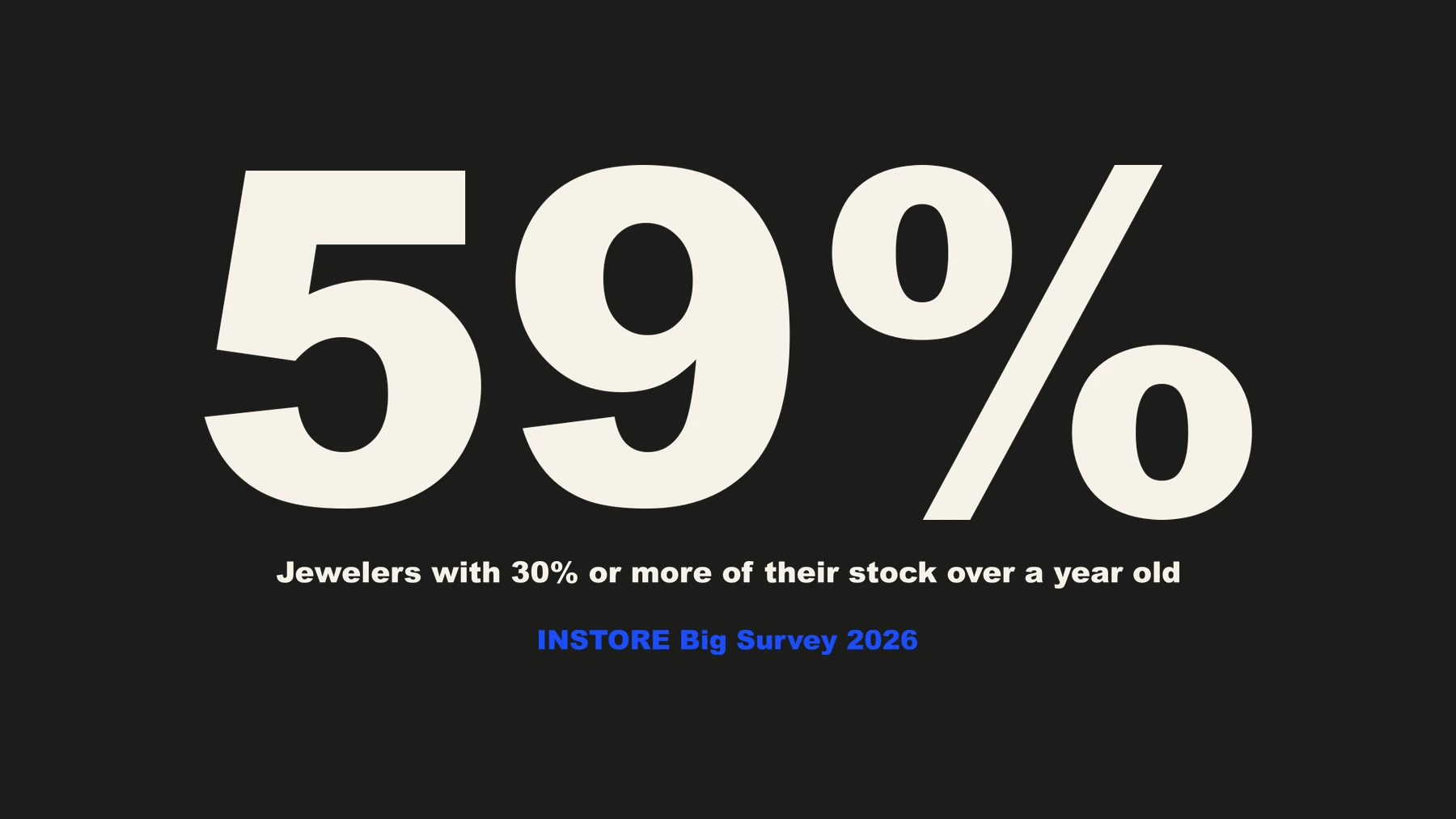
For most stores, 30% or more of it. 59% of jewelers say at least 30% of their inventory is over a year old, against 60% last year. [Survey; Our arithmetic — bands added together] Only 39% are under the 30% line INSTORE used as its benchmark in 2025. The share with more than half their stock aged fell from 19% to 16%, but the share under 10% fell too, from 9% to 6%. INSTORE itself calls the picture virtually unchanged.
Which jewelry lines are selling best?
No line dominates. Allison-Kaufman came first for the third year running with 47 votes, ahead of Sylvie on 33 and Stuller on 30, in a survey of more than 500 stores where each could name three. [Survey] Citizen, Seiko and Rolex led watches. Rolex, Omega and Cartier topped the list of brands jewelers would most like to add, and close to three in ten named no brand at all. [Survey] The full rankings are in INSTORE's report.
What saves a sale that is about to walk out?
Usually not a clever line. INSTORE's collection of jewelers' best saves points the same way again and again, and each story is one store's account: [Practitioner]
- A second person steps in. A colleague connects over something unrelated, and the conversation opens up.
- Somebody looks in the back. One store remembered a ring in its gold-buy stock just as a customer reached the door.
- The risk comes off the table. One store lends pieces for a 30-day trial and reports returns under 1%.
- The small job gets a yes. One store took a repair five others had refused, and the same client returned a month later and spent $35,000.
What does this mean for the independent jeweler?
It means the feeling that your customer base is narrowing is common, and you should check it before acting on it. About half of your peers share it, but it did not grow this year, and the owners' own estimates of their top clients came down rather than up. Nobody has published till data that settles it, so the only store you can get a true answer for is your own. That matters, because the two wrong answers cost different things: a store that wrongly decides only its wealthy clients matter stops marketing to the town, and a store that does not know who its best clients are risks losing them without noticing. Meanwhile aged stock has barely shifted, and the interest owners report is in lab-grown and estate, not only in the bridal case.
What's the solution?
Replace the impression with your own numbers, then act on them.
- Work out your own top-5% share this week. Export last year's sales by customer from your point-of-sale system, sort by spend and add up the top 5%. It takes an afternoon.
- Count your new customers. Compare first-time buyers this year with last year. This is the number that tells you whether your pool is really shrinking.
- Call your top list before December. A personal call from the owner, about the person and not a promotion.
- Keep saying yes to small jobs. Repairs are how new people meet the store. We covered why in the repair post.
- Run an aged-stock report every month. Compare your share over a year old with the 30% line, and give those pieces a push before any markdown.
- Log what people ask for. Have staff note every request for four weeks, including what you did not have. Then compare it with this survey's list.
- Agree a save routine. Before a customer leaves undecided, a second person says hello and somebody checks the back.
At My Jewelry Marketing we build for both ends of this. The owner keeps the relationship with the best clients, because a post is no substitute for that call. The months we make and post on Facebook do the other job: showing repairs, custom work and what is in the case to the people in town who have not been in yet.
The short version
In INSTORE's 2026 Big Survey, 51% of independent jewelers say they sell more to fewer customers, against 52% in 2025. The share making more small sales to a larger pool fell from 18% to 12%, while "no change" rose from 27% to 35%. Most stores estimate that their top 5% of customers bring in 20–30% of sales, and the share putting it at 30% or more fell from 45% to 39%. Customer interest is highest in lab-grown diamonds at 53% and estate pieces at 37%, against 23% for natural diamonds. 59% say at least 30% of their stock is over a year old. All of it is self-reported, and no till data settles the question, so work out your own top-5% share and count your new customers.
Get this for your own store
Who your next customers are depends on who lives near you. A free strategy for your store, built from your postal codes and the published Census figures for the people in them, is at myjewelrymarketing.com/demo/strategy. Paste your website address and read it in a couple of minutes.
Sources
Compiled by My Jewelry Marketing — myjewelrymarketing.com. The year-on-year comparisons and added-together bands are ours; INSTORE did not publish them in this form.
- 2026 sales concentration, top-5% share, customer interest, brands, breakout trends, best saves and aged stock, with the 2025 aged-stock figures. "The Big Survey 2026: Buying & Selling," INSTORE, 1 November 2026. Sample for each question not stated.
- 2026 sample. INSTORE, "The Big Survey 2026": more than 500 independent owners and managers. The Basics: 47 states, 89% with one store.
- 2025 sales concentration and top-5% share. "The Big Survey 2025: Performance," INSTORE, 5 November 2025. 631 responses. The 2025 question said "rich" where 2026 says "wealthier". The 2025 top band read 60%; the 2026 list adds 80% or more, at 0.3%, which we count in the 40%-or-more line.
- INSTORE's 2025 commentary. "10 Takeaways from the 2025 Big Survey," INSTORE.
- The 30% aged-stock benchmark. "The Big Survey 2025: Selling," INSTORE, 22 October 2025.
- A point-of-sale measure of customer concentration at independent jewelers. No published source found.