Lab-grown is now two businesses. In bridal it grew 31% in sales in 2025 but loose stones began declining; in fashion, finished jewelry rose on units and average price together for the first time.
Most reporting on lab-grown diamonds still treats the category as a single line going one direction. At the resolution the point-of-sale data now allows, that reading is not just imprecise — it is actively misleading, and it will lead you to the wrong holiday buy.
Each figure below carries a label saying how much weight it can hold. [Measured] means a named study with a real sample stands behind it. [Survey] means a survey. [Not measured] means the industry repeats it constantly and nobody has ever measured it. Where no reliable source exists, this says so rather than filling the gap. The wider picture these figures sit inside is in the state of independent jewelry retail in 2026, one of a series at myjewelrymarketing.com.
The headline number, and why it hides the story
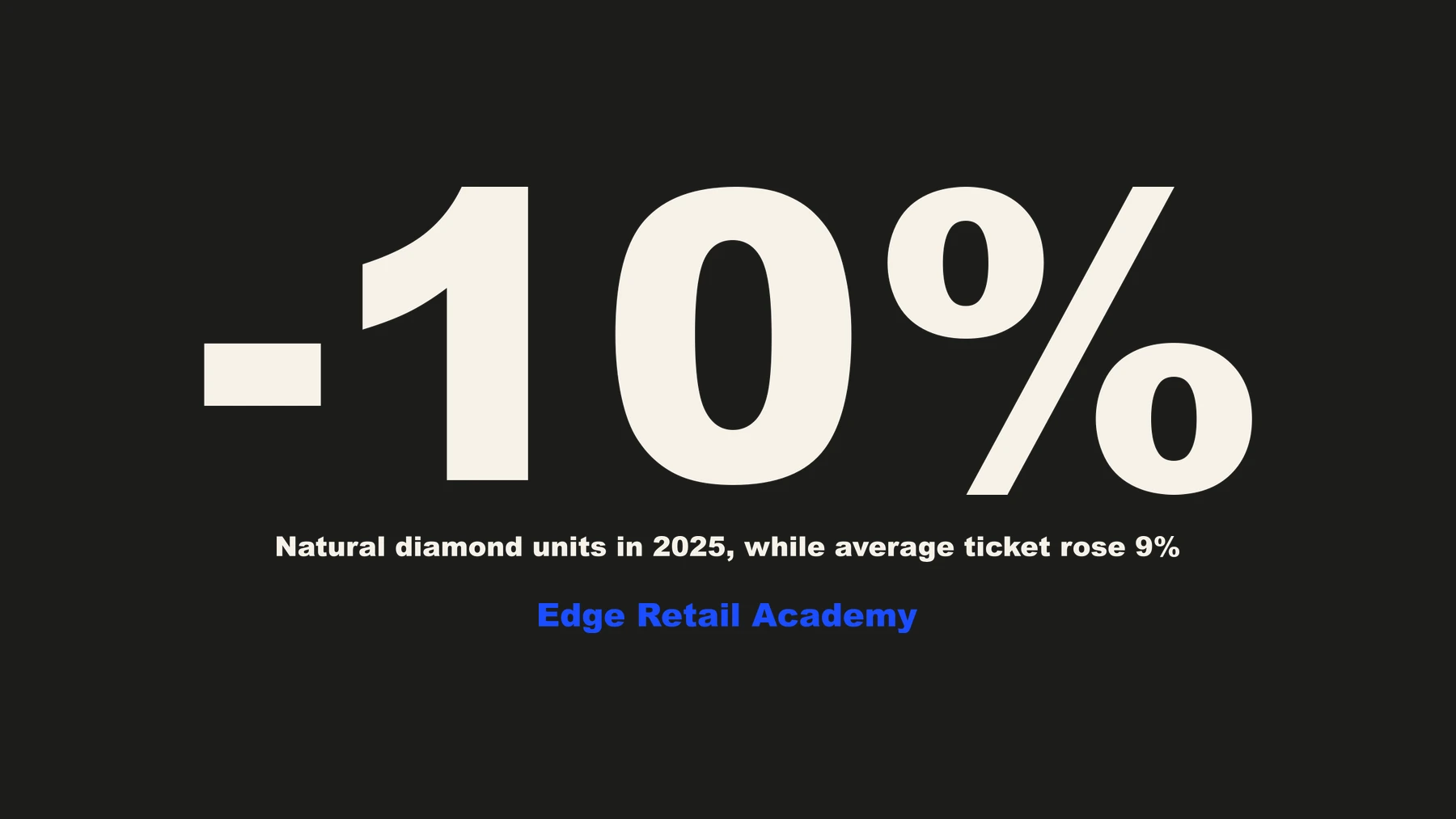
Across US independents in 2025, taking lab-grown as one category: sales up 13%, units up 19%, and average ticket down 5%. All natural diamond, over the same period: sales down 2%, units down 10%, and average ticket up 9%. [Measured]
Read at that altitude it is the familiar story — lab-grown taking volume, natural under pressure, prices falling. Every element of that is true of the aggregate and none of it is useful, because the aggregate is two different businesses averaged together.
Split it into bridal and fashion, and it separates cleanly
The same data, cut by engagement rings rather than by material:
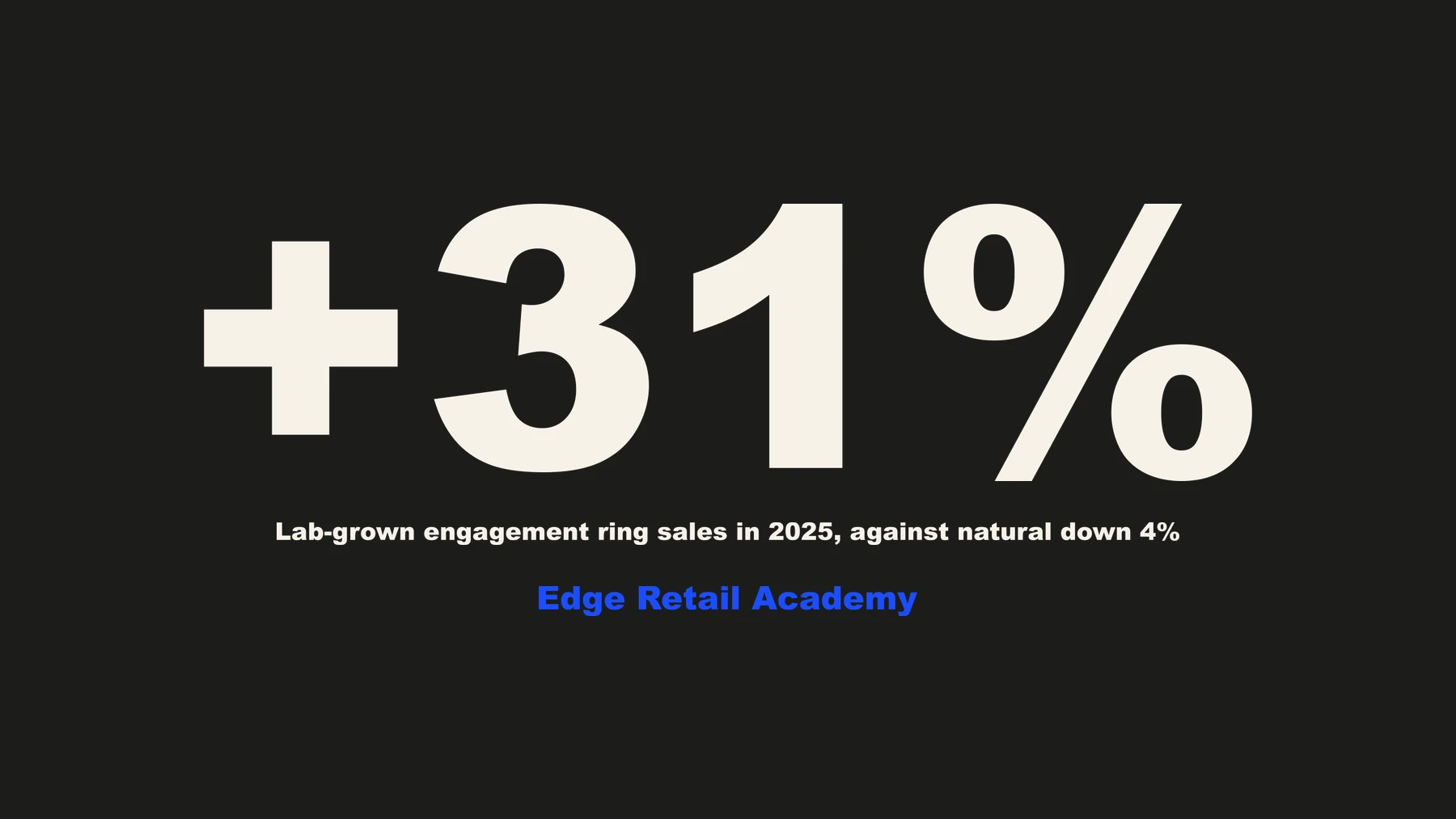
- Lab-grown engagement rings: sales up 31%, units up 30%. [Measured]
- Natural engagement rings: sales down 4%, units down 2%. [Measured]
Two things worth noticing there, and the second one gets missed.
First, lab-grown's bridal growth is far ahead of its whole-category growth — 30% in units against 19% overall. Bridal is where the momentum actually is.
Second, natural engagement is down slightly, not collapsing. Minus 2% in units is a soft year, not an exit. Set that against natural's whole-category figure of minus 10% in units and the implication is uncomfortable for how most stores merchandise: the natural diamond business that is really under pressure is the fashion half, not the bridal half — and fashion is the half almost nobody markets natural diamonds into.
January 2026 is where the price story cracked
Then something happened that had not happened before. In January 2026, loose lab-grown unit sales declined for the first time ever, while finished lab-grown jewelry saw units and average prices rise together — also a first. [Measured]
The distinction is the whole point, and it is a distinction about your own counter rather than about the market in the abstract:
- Loose stones are bridal centres. Somebody is choosing a stone and having it set.
- Finished pieces are fashion. Studs, tennis bracelets, pendants, bought as pieces.
So loose is softening while finished is strengthening on volume and price at the same time. Lab-grown is maturing out of a price story in bridal and into a volume story in fashion.
One honest caveat, because this blog does not pretend a month is a trend: that is a single month of point-of-sale reporting. It is the first reading of its kind, which makes it significant, and it is one reading, which means the direction is worth acting on and the magnitude is not. Watch whether it holds through the autumn before rebuilding a case around it.
What that means for the holiday buy
Merchandising for two businesses that share a material is different from merchandising for one trend, and the practical consequences are specific:
- Stop treating lab-grown as the value option. In finished jewelry, units and average price rose together — that is a category with room to be merchandised up, not one that needs discounting to move. Presenting it as the cheap alternative leaves margin on the table in the only lab-grown segment currently strengthening on both measures.
- Buy loose and finished on different logic. They are moving in opposite directions. A single lab-grown open-to-buy, split by whatever the vendor is pushing, is the mistake this data exists to prevent.
- Do not read natural's soft units as a bridal problem. Natural engagement is down 2%. Natural overall is down 10% on units while its average ticket rose 9% — fewer buyers, each spending more. That is a customer self-selecting toward significance, which is a merchandising and conversation opportunity, not a retreat.
- Decide what you say before somebody asks. The store that has an unembarrassed, consistent answer to "what is the difference?" sells both. The store that improvises a different answer each time sells whichever one the customer already decided on.
Stones are getting bigger, and lab-grown is why
The size shift is one of the clearest measured movements of the last two years. Average centre stone reached 1.9 carats in 2025, against 1.7 in 2024 — with natural averaging 1.6 and lab-grown 2.0. [Measured]
Independently of that, De Beers reports average natural diamond jewelry carat weight rising to 1.86 from 1.65 in 2023, with average price per piece up 25%. [Measured]
Both point the same way. Lab-grown reset what a centre stone is expected to look like, and the natural side did not respond by shrinking — it went up in weight and in price per piece. The customer walking in has a bigger stone in mind than the customer of two years ago, whichever material they end up buying.
The gap almost nobody markets into
Here is the largest unworked opening in this whole picture. Three-quarters of natural diamond demand has nothing to do with engagement — and nearly all natural-diamond marketing is bridal-coded, in imagery, language and timing. [Measured]
That is a very large, very cheap gap for an independent willing to talk about natural diamonds outside of a proposal: anniversary, milestone, self-purchase, the piece bought because a person wanted it. It is also exactly the half of the natural business the units data says is under most pressure. The pressure and the gap are the same fact seen twice.
Silver is not the escape hatch
One widely repeated piece of strategy deserves correcting here, because it is usually offered as the answer to everything above.
The advice is to trade customers down into silver when the diamond conversation gets difficult. The data does not support it. Silver and alternative metals at US independents show units down every single month through 2026 — April down 10%, June down 9%, July down 8% — while silver's average sale inflates as well. [Measured]
That is not a category absorbing traded-down customers. The silver customer is buying less silver. Whatever the softness in diamond units is doing, it is not landing in silver, and a store rebalancing its buy toward silver on the strength of that advice is buying into a declining unit line.
What is doing well, with numbers behind it
Two more measured movements, since they bear on the same buy:
- Yellow gold has come back hard. 39% of 2025 engagement rings, up roughly 140% over five years, against 35% white gold and 13% platinum. [Measured] Separately, 94% of surveyed jewelers name yellow gold the most popular metal in their store. [Survey] White metals still lead in aggregate at 48%, so this is a shift rather than a replacement — read it as momentum, not as a finished changeover.
- Custom is now the norm in bridal, not the exception. 90% of 2025 engagement rings were customised or custom-designed. [Measured] Which makes process and design content the highest-intent thing an independent can post, and makes "we can make exactly that" a more accurate description of the category than any product photograph.
And what has no data behind it at all
Worth saying plainly, because these appear in trend lists beside the figures above as though they were the same kind of claim. There is no reliable measured US sales data on moissanite, salt-and-pepper diamonds, toi et moi settings, hidden halos or east-west settings. [Not measured]
None of that means they are not selling. It means nobody has measured how much, and anybody presenting them as trends with a size is inventing the size. Treat them as styling vocabulary — useful for describing what you make and photograph, useless for deciding an open-to-buy.
The short version
Lab-grown split in two and the trade press mostly has not caught up. In bridal it is a maturing price story with softening loose-stone volume; in fashion it is a strengthening volume story where units and average price rose together for the first time. Natural did not collapse — its engagement half is roughly flat and its fashion half is where the real pressure sits, which happens to be the half nobody markets. Stones got bigger on both sides. Silver is not catching anybody trading down.
If you take one decision from this into the holiday buy: stop pricing your finished lab-grown as the cheap option, and say something about natural diamonds that is not about getting engaged.
Get this for your own store
What the split means for your buy depends on who is actually walking in — the ages, incomes and household mix of your own trade area, which decide whether your lab-grown business is bridal, fashion or both. That analysis, built from your postal codes and the published Census figures for them, is free at myjewelrymarketing.com/demo/strategy.
Sources
Compiled by My Jewelry Marketing — myjewelrymarketing.com.
- Lab-grown and natural performance, 2025 and monthly 2026. Edge Retail Academy point-of-sale data from approximately 2,000 US jewelry retailers, via INSTORE Magazine and National Jeweler; monthly market trends.
- Loose versus finished lab-grown, January 2026. Tenoris reporting, monthly retail sales, February and July 2026.
- Centre stone weights and metal share. The Knot 2026 engagement research via Rapaport, 19 February 2026, n=10,474 couples.
- Natural carat weight and price per piece. De Beers carat weight and price reporting.
- Yellow gold in-store popularity. INSTORE survey reporting; the publisher does not disclose a sample size for the 94% figure.
- Silver and alternative metals. Edge Retail Academy monthly reporting via INSTORE, 2026.
- Natural diamond demand outside engagement. De Beers demand reporting.