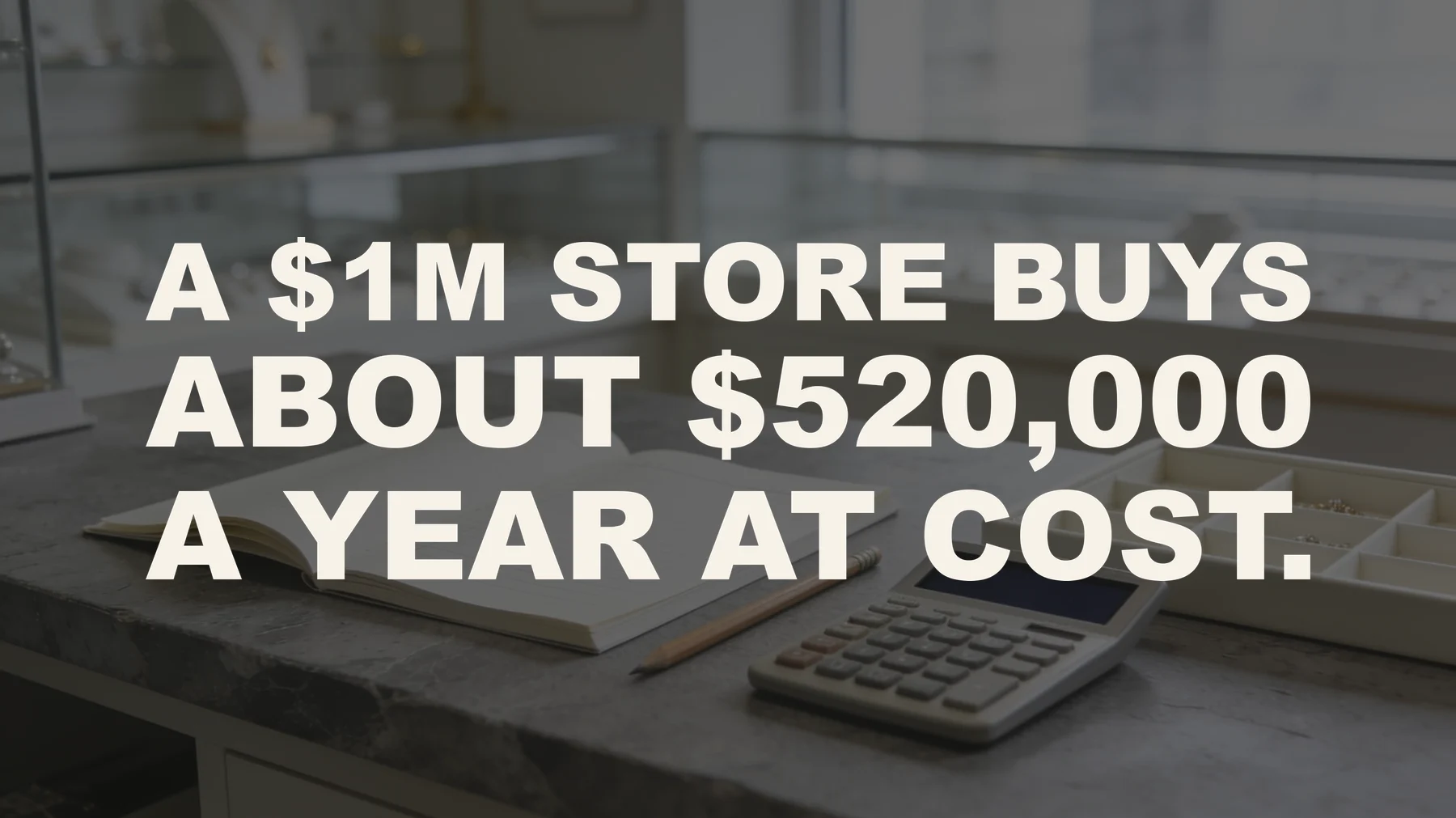
Open-to-buy is planned sales plus markdowns plus planned ending stock, minus what you hold; a $1M store at 48% margin buys about $520K a year at cost.
Each figure below carries a label saying how much weight it can hold. [Measured] means a named study with a real sample stands behind it. [Survey] means a survey, with its sample size where one is published. [Practitioner] means the trade agrees but nobody has measured it. [Not measured] means nobody has measured it and the industry repeats it anyway. [Stale] means it was real once and is too old to quote as current. Anything marked [Our arithmetic] is a calculation in this article, not a finding from a source.
One of a series at myjewelrymarketing.com checking which parts of the advice given to independent jewelers anybody has measured; the wider picture is in the state of independent jewelry retail in 2026.
What is open-to-buy?
It is the amount you can spend on new product in a period without ending up with more stock than you planned. The standard retail formula:
Planned purchases = planned sales + planned reductions + planned end-of-month stock − beginning-of-month stock
Reductions are markdowns, staff discounts and shrinkage. Subtract anything already on order and you have your open-to-buy at retail. Multiply by the share of the retail price that is cost and you have it at cost — at a 48% gross margin, that is 52 cents on the dollar. [Practitioner — standard retail textbook method]
The formula is not the hard part. The hard part is that every input is a plan, and most stores do not write their plans down.
How much new product does a $1 million jewelry store buy a year?
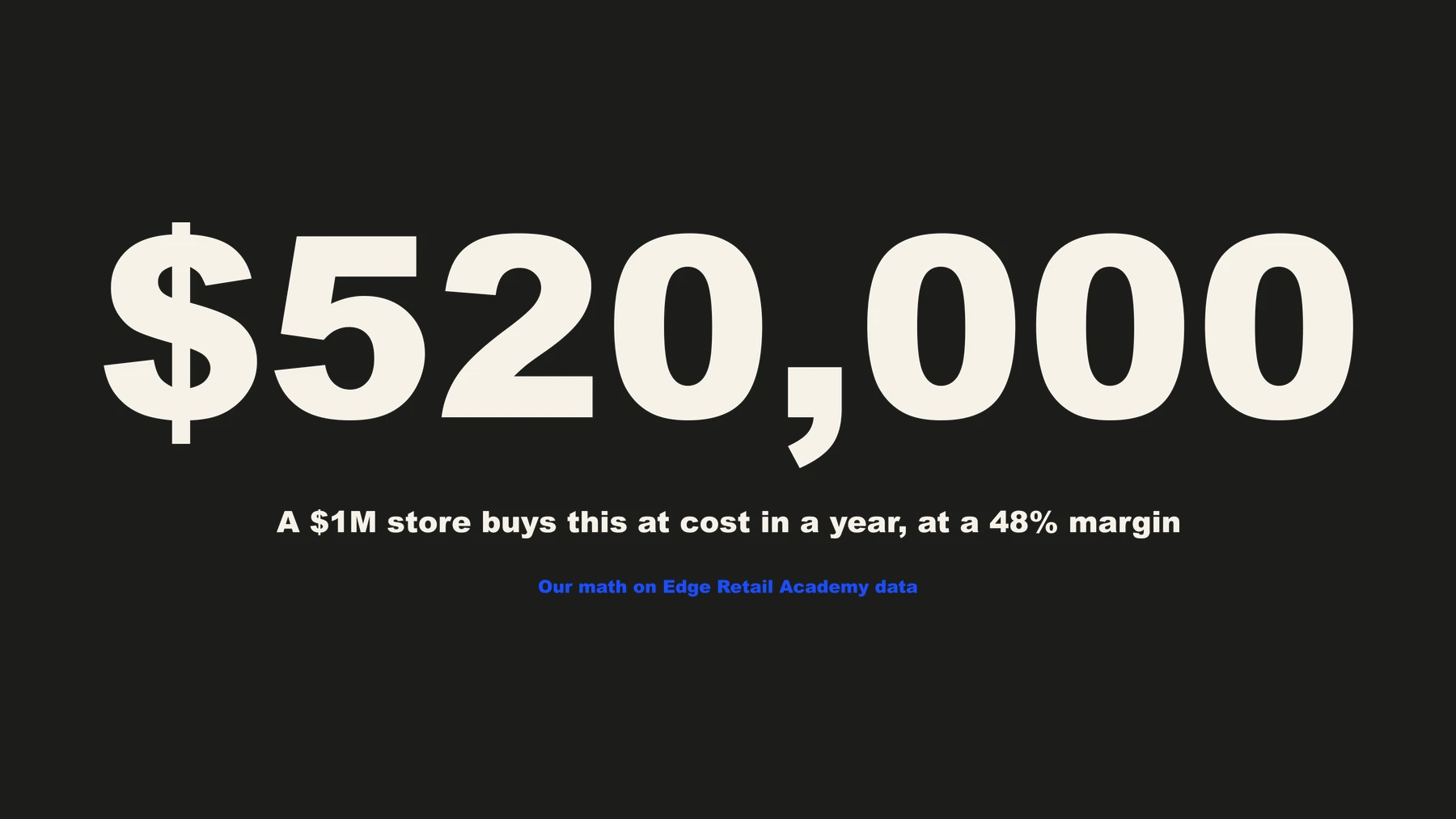
About $520,000 at cost, if the store keeps the same amount of stock all year. [Our arithmetic] The reasoning:
- Independents averaged a 48% gross margin, across roughly 1,500 stores on one point-of-sale system, as reported in December 2025. [Measured]
- At a 48% margin, $1,000,000 of sales costs $520,000 in goods.
- If you end the year holding the same stock you started with, you bought what you sold — $520,000 at cost.
Two things move that number. If you are cutting aged stock, you buy less. And part of what you sell is not case stock at all: special orders and repairs carry their own cost but never sit in a case waiting to be bought. In one jewelry consultant's worked example, special orders were 21% of holiday business and repairs 8%. [Practitioner — one illustrative store; Stale] Take out a share like that and the money left for new case stock falls to roughly $370,000–$450,000. [Our arithmetic]
Doesn't inventory turn decide how much I buy?
No — and this is the most common confusion in the subject. Turn decides how much stock sits on your floor, not how much you buy in a year. At a 48% margin, a $1 million store that turns its stock once a year holds about $520,000 at cost on average; one that turns 0.7 times holds about $743,000. [Our arithmetic] Both buy roughly the same amount. The slower store just has $223,000 more tied up in cases while it does.
What a typical independent turns is not well documented. The trade's own press puts it at "somewhere between 0.7 and 1.2", citing unnamed sources, and a 2023 reader poll split exactly in half on whether stores beat a 1.0 turn. [Practitioner — sources not named] We found no current, published, measured turn figure for independents. [Not measured]
Do jewelers who manage inventory make more money?
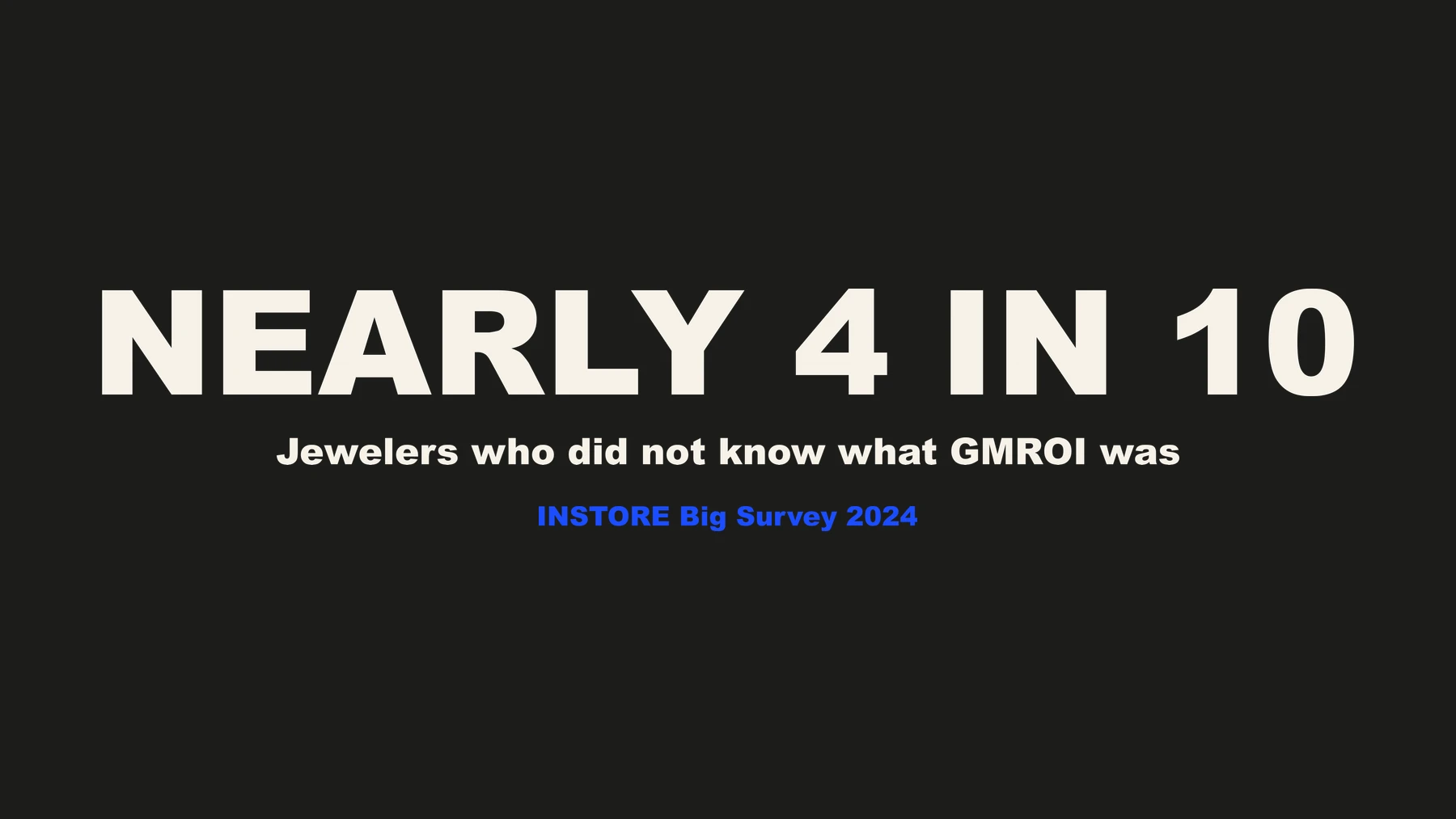
The survey evidence says the most profitable ones at least watch it more closely. In INSTORE's 2024 survey, 51% of its most profitable group had a GMROI above $1.00, against 29% of its least profitable — and nearly four in ten respondents did not know what GMROI was. [Survey — more than 700 stores]
GMROI is gross margin dollars divided by average inventory at cost: how many dollars of margin each dollar sitting in your cases earns in a year. At a 48% margin and a turn of one, it is about $0.92. [Our arithmetic] That "thriving" stores were defined partly by GMROI above $1.00 means the survey cannot prove GMROI causes profit — but it does show where the profitable stores are paying attention.
When should a jewelry store plan its holiday buying?
Before the season you are buying for, because the orders go in early. Independents typically place holiday orders in September and October, and higher-volume buyers in August, according to one manufacturer. [Practitioner; Stale, 2018]
The holiday is the month the plan matters most. Black Friday to New Year's Eve was 20–29% of annual sales for 41% of stores, and 30% or more for 27%. [Survey — sample size not disclosed on the results page] In federal sales data, December alone was 18.8% of jewelry-store sales in 2019. [Measured — includes chains; Stale, 2019]
The cautionary tale every jewelry buyer should know is in that same consultant's example: a store planned $850,000 of holiday sales, had about $302,000 of open-to-buy for new stock — and bought $590,000, finishing the season with $165,000 of surplus. [Practitioner — one illustrative store; Stale] His rule: "Only buy a level of stock that you will sell."
A worked month
Here is one month for a $1 million store, using the formula above. The inputs are illustrative; replace every one of them with your own. [Our arithmetic]
- Planned November sales: $85,000 retail (8.5% of the year, the share November held in the federal data)
- Planned reductions: $4,000 retail
- Planned end-of-November stock: $1,050,000 retail (building toward December)
- Beginning-of-November stock: $1,000,000 retail
- Planned purchases: $85,000 + $4,000 + $1,050,000 − $1,000,000 = $139,000 at retail
- At cost (52%): $72,280
- Already on order: $30,000 at cost
- Open-to-buy for November: $42,280 at cost
That last number is the one to hand to every vendor conversation that month.
What does this mean for the independent jeweler?
It means the size of your buying budget is mostly settled by arithmetic you can do yourself, and the parts that are not are the parts nobody has measured. The 48% margin is current and well sampled. The turn benchmarks are old, unnamed or both, and no one publishes what share of sales a jeweler should spend on new stock. So don't adopt a turn target or a buying percentage from someone else's store without knowing where it came from. What you can control is having a plan written before the vendor arrives — because the most expensive line in the consultant's example is the $165,000 bought with no plan to sell it.
What's the solution?
Build the plan once, then let it say no for you.
- Pull last year's sales by month and by category. Your point-of-sale system has it. This is the base of every number above.
- Set planned sales for each month. Last year plus or minus what you honestly expect.
- Decide how much stock you want at the end of each month. Higher going into December, lower coming out of it.
- Run the formula for each month, at retail and at cost. Subtract what is already on order.
- Take out special orders and repairs. They have their own cost and should not use up case-stock budget.
- Split the month's open-to-buy by category before you split it by vendor. Bridal, fashion, lab-grown, gold, silver. The category decides the vendor, not the other way round.
- Check it every month. If November ran ahead of plan, you have more to spend in December; if it ran behind, you have less — and the plan tells you before the stock arrives.
At My Jewelry Marketing we build a store's marketing calendar from the same seasonal shape — when your sales actually arrive, month by month — so that the posts promoting a category land while that category is in the case, not after it has sold through or before it has arrived.
The short version
Open-to-buy is planned sales plus planned reductions plus planned ending stock, minus beginning stock and anything already on order. At the current 48% gross margin, a $1 million jewelry store that holds its stock level flat buys about $520,000 of product a year at cost, and less once special orders and repairs are taken out. Inventory turn changes how much money sits in your cases, not how much you buy, and there is no current measured turn benchmark for independents. Plan by month and by category, take out special orders, and hand the number to every vendor before the conversation starts — the worst outcome in the trade's own example is a store that bought nearly twice its plan.
Get this for your own store
Your buying calendar and your marketing calendar should be the same shape. A free strategy for your store — built from your postal codes and the published Census figures for the people in them, with a month-by-month plan — is at myjewelrymarketing.com/demo/strategy.
Sources
Compiled by My Jewelry Marketing — myjewelrymarketing.com.
- The open-to-buy formula. Robert Danielson, Retail Management, Module 11, "Merchandise Flow," Lumen Learning, CC BY 4.0. A plainer statement with the on-order step: Shopify, "Open-to-buy plans".
- 48% gross margin. Edge Retail Academy data, about 1,500 independents, via The Centurion, 24 December 2025. The period the margin covers is not stated.
- Turn range and reader poll. Trace Shelton, INSTORE, 17 December 2023. Sources for the range not named; poll sample not disclosed.
- GMROI and profitability. INSTORE Big Survey 2024, 22 October 2024. More than 700 respondents.
- Holiday buying example. Malcolm Alderton, INSTORE, September 2003. One illustrative store.
- Holiday share of annual sales. INSTORE, "The Big Survey 2025: Performance," 5 November 2025. The survey drew 631 responses; the results page does not state the sample for this question.
- Monthly share of jewelry-store sales. US Census Bureau Monthly Retail Trade, jewelry stores, not seasonally adjusted, via FRED. 2019; includes chains; shares calculated by us.
- Holiday order timing. Rapaport, 26 November 2018. One manufacturer's account.
- A share-of-sales rule for buying, and a current measured turn benchmark. No published source found.