US jewelry stores are closing at about 2.4% a year, but it is retirement rather than failure: in Q1 2026, 107 stopped trading and four went bankrupt.
Each figure below carries a label saying how much weight it can hold. [Measured] means a named study or a published count stands behind it. [Survey — n=…] gives the sample size where the publisher discloses one. [Stale] means it was real once and is too old to quote as current. [Not measured] means nobody has measured it and the industry repeats it anyway. Where a number is our own arithmetic on somebody else's published figure, it says so.
One of a series at myjewelrymarketing.com checking which parts of the advice given to independent jewelers anybody has measured; the wider picture is in the state of independent jewelry retail in 2026.
Why are jewelry stores closing?
Because their owners are retiring, and a large share of them had no plan for what came next. Not because they were competed out of business.
The count first. At the end of the first quarter of 2026 there were 16,667 retail jewelry businesses in the United States, down from 17,084 a year earlier — a fall of 417 businesses, or 2.4%. That pace has been remarkably steady, running at roughly 400 to 500 retailers a year since at least 2022, and it adds up to about 1,700 fewer stores than in late 2021. [Measured]
Those are the Jewelers Board of Trade's own listings, from its Q1 2026 Vital Statistics report. They count businesses with a door and a trade area, which is the number that describes your actual competitive set — see the section below on why you will also see a figure four times larger.
Four bankruptcies. That is the entire failure column.
Here is the breakdown that changes what the store count means. In the first quarter of 2026, US retail jewelers left the JBT rolls like this:
- 107 ceased operations — the owner closed the business. Down from 139 in Q1 2025. [Measured]
- 17 were consolidated through a sale or merger. Down from 27. [Measured]
- 4 filed for bankruptcy. Up from two. [Measured]
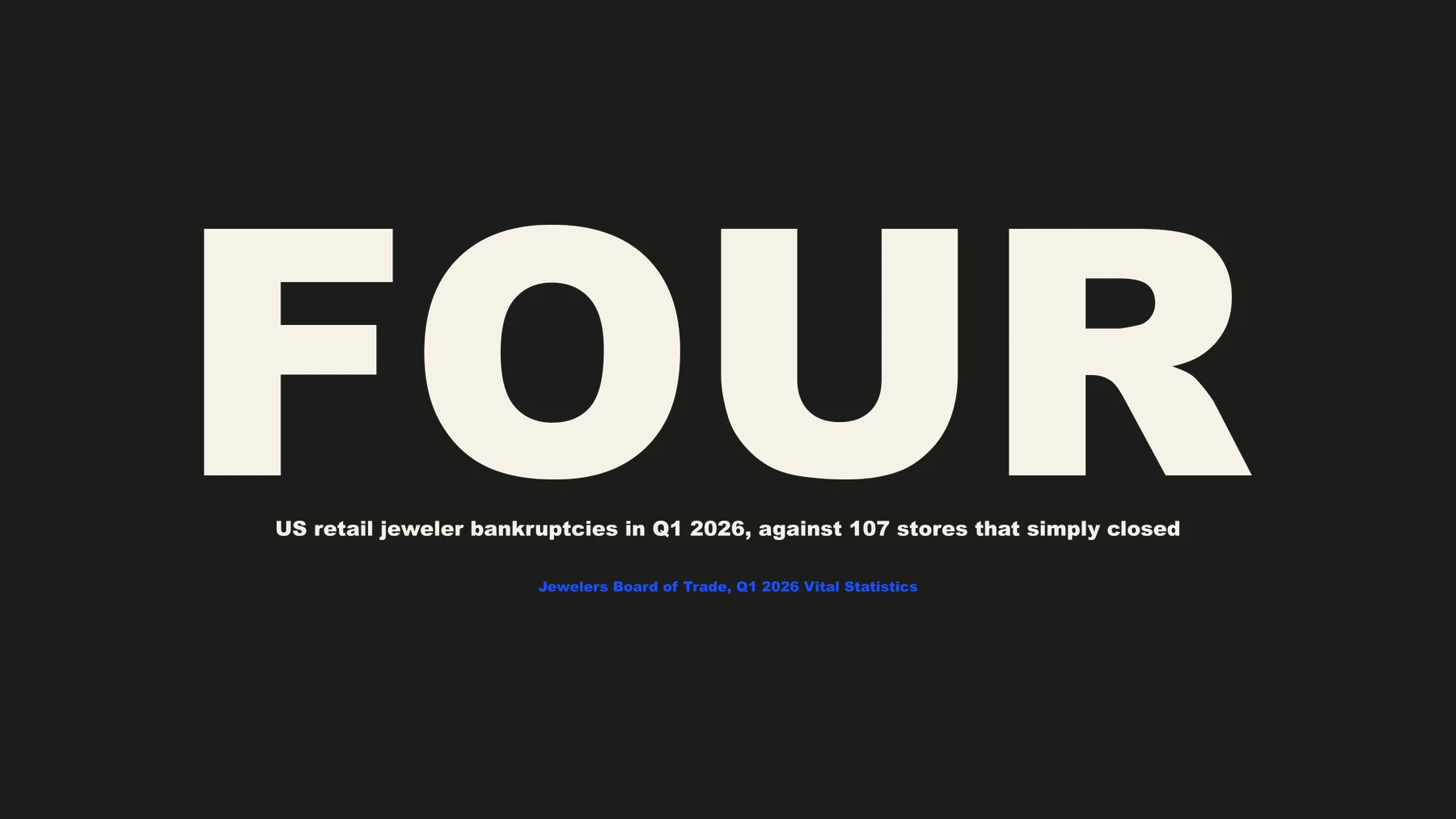
That is 128 exits, of which four were failures — about 3% of them. [Our arithmetic on JBT's published counts.] The rest is a business ending on its owner's terms, or being bought by somebody who wanted it.
The distinction is not academic, because the two stories imply opposite strategies. A channel being competed out of existence tells you to defend on price and match whatever the internet is doing. A channel whose owners are ageing out tells you the opposite: the customers of those 107 stores are still in their towns, still buying jewelry, and currently looking for somebody to replace a jeweler they trusted for thirty years.
Fewer doors is not less demand. It is the same demand, redistributed to whoever is findable at the moment it moves.
71 stores opened, and that number went up
The closure figure gets quoted on its own, which makes the channel sound like it is emptying. It is not. In the same quarter, US retailers opened 71 new locations, up from 68 a year earlier. [Measured]
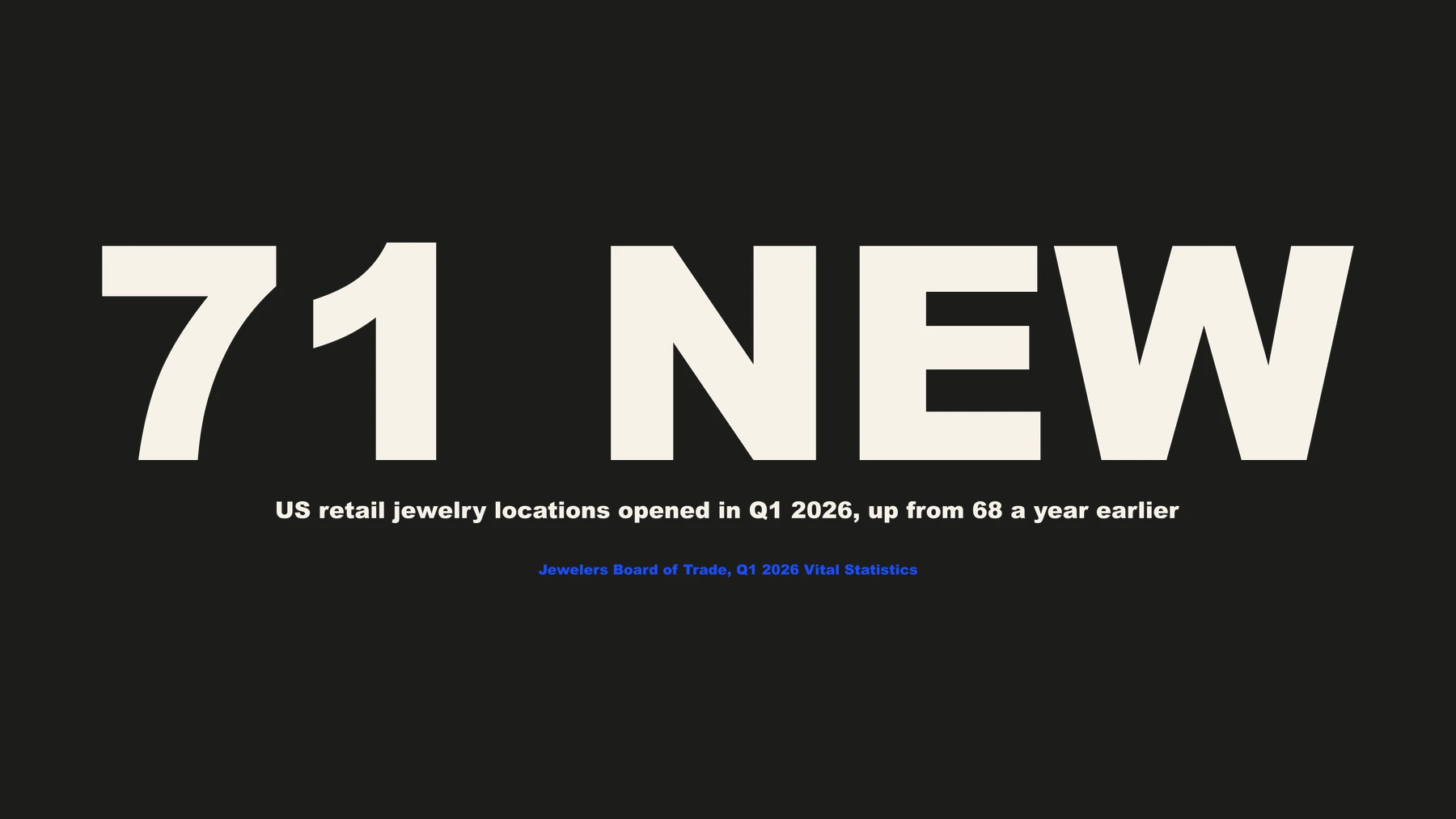
Net, the channel still shrank — 71 openings against 128 exits. But an industry nobody wanted to enter would not be seeing new doors open at all, let alone more of them than the year before. People are still starting jewelry stores in 2026, and slightly more of them than in 2025.
Read the two numbers together and the shape is a generational handover that is only partly happening: a large cohort leaving, a smaller cohort arriving, and a gap between them that is being filled by the stores already standing.
The store count everyone quotes, and the one that describes your competitors
A quick correction, because both numbers are real and they are not measuring the same thing.
If you have read that there are 70,000-plus jewelry businesses in America, or that the industry is worth $60.3 billion, those figures come from industry-research firms counting by tax classification. That definition sweeps in sole proprietors, part-time online sellers, and anybody filing under the same code. It is how you arrive at an average American "jewelry store" with 2.4 employees. [Measured]
Neither figure is wrong. They are answering a different question. When you are sizing your competitive set — who else in your area has a door, a staff and a trade area — 16,667 is the number, and it is the one that has fallen 1,700 since 2021.
Quoting the larger number at yourself makes your market look crowded and your share look trivial. Quoting the smaller one tells you how many businesses are actually doing what you do.
What the succession data says, and how old it is
This is the part with the weakest evidence in the article, and it is also the most-quoted, so the date matters more than the percentages.
When Jewelers of America surveyed retailers for its Business Pulse survey, 204 jewelers responded and 177 of them — 92% — were family-owned businesses. Among those 177:
- 83% reported an owner over 50, split 38% aged 50 to 59 and 45% over 60. [Survey — n=177 family-owned]
- 40% said the next generation would take over at retirement. [Survey — n=177]
- 26% had no succession plan at all, and a further 22% intended to sell or simply close — 48% between them. [Survey — n=177]
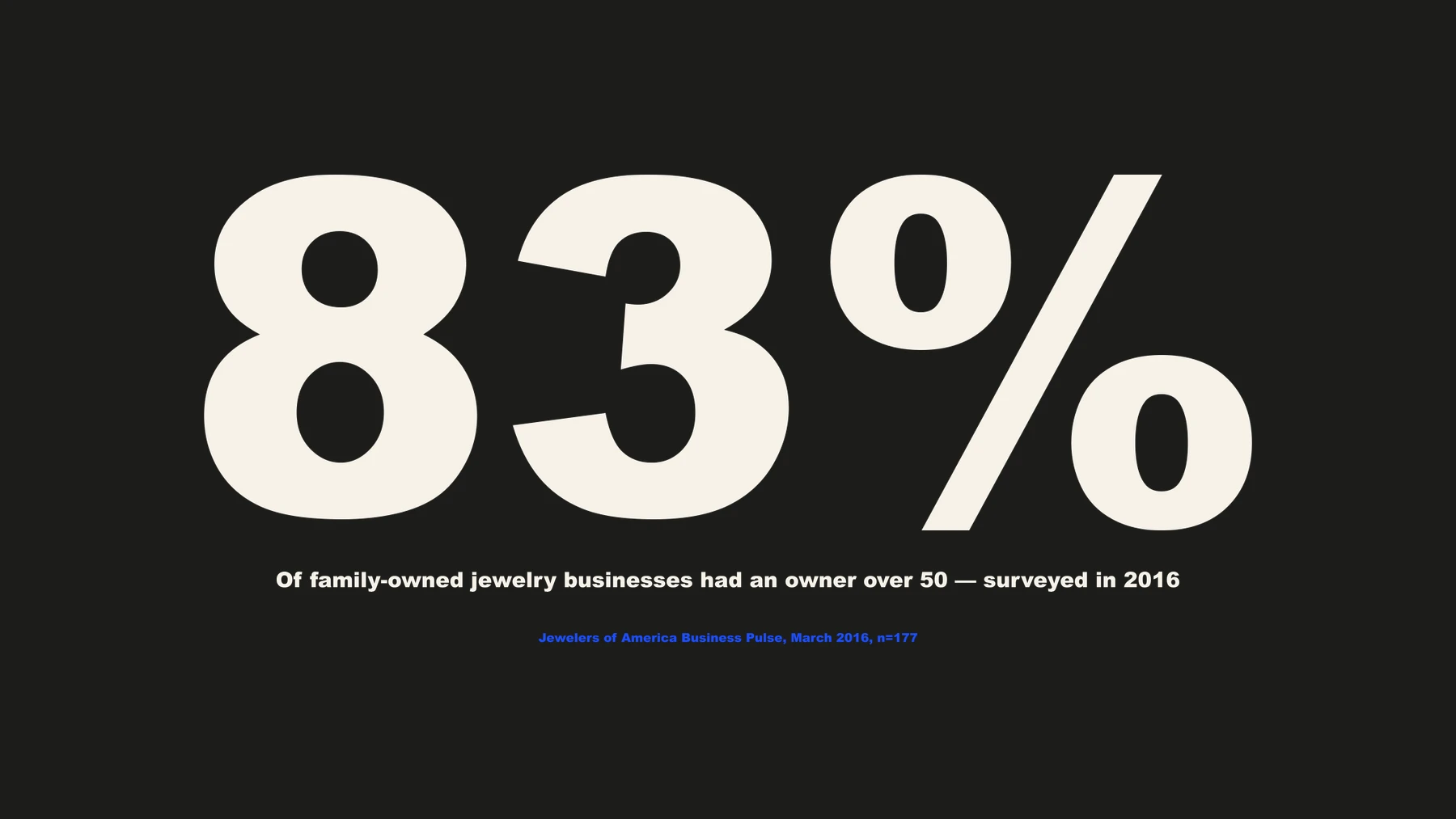
That survey was conducted in March 2016. [Stale] It is ten years old, it is the most recent one of its kind we could find, and it is quoted constantly without its date attached. So read it as a shape rather than as today's percentages.
The shape is almost certainly deeper now rather than shallower, for a reason that needs no new data: every owner in that survey is ten years older. A 55-year-old owner in 2016 is 65 today. And the closure data since — overwhelmingly cessations, four bankruptcies in a quarter — is precisely what a survey like that predicts will happen next.
What nobody has published is the current version. No survey since 2016 measures US jewelry succession planning, so anyone giving you a 2026 percentage is giving you the 2016 one with the date filed off. [Not measured]
What this means for the store still standing
Three things, and they land differently depending on which end of a career you are reading from.
- The competitive set thins ahead of you. Roughly 400 to 500 US retail jewelers a year stop trading, and almost none of it is bankruptcy. Those stores had customers, and those customers are still there.
- Be findable at the moment a jeweler disappears. This is the practical consequence and it is worth more here than in almost any other trade. When a store closes, its customers do not stop buying jewelry — they start looking, usually locally, often for the first time in decades. Whoever is visible and credible that week inherits the relationship.
- The handover gap is an opportunity and a warning at once. Fewer doors and steady demand is a good position. It is also a description of what happened to the stores that closed: they were in that same good position, right up until there was nobody to hand it to.
If you are the generation coming in, the arithmetic is in your favour and the main job is visibility.
If you are the generation going out — and a lot of readers of a piece like this are — the honest reading of the data is that about half your peers reached this point without a plan. That is not a criticism of them. Succession is a genuinely hard problem involving family, money and identity all at once, and the survey above suggests it is normal to arrive at it undecided. It is worth one uncomfortable afternoon, whatever you decide, because the closure data is what "undecided" looks like at scale.
What is not measured here
- There is no current succession survey. The 2016 Jewelers of America figures are the most recent we could find, and every circulating "half of jewelers have no succession plan" claim traces to them. We have stated the date rather than dropping it. [Not measured]
- The reason for each closure is not recorded. JBT counts a cessation; it does not ask why. That closures are overwhelmingly cessations rather than bankruptcies is measured, and reading "cessation" as "retirement" is an inference — a strong one, given the age data, but an inference. [Measured count, inferred cause]
- No study measures where a closed store's customers go. That they go somewhere is not in doubt; that being findable captures them is a mechanism, not a measurement. [Not measured]
The short version
There were 16,667 US retail jewelry businesses at the end of Q1 2026, down 417 — 2.4% — on the year, and about 1,700 down since late 2021, at a steady rate of 400 to 500 a year. But the composition of that decline is the story: of 128 US retail jewelers that left the rolls in Q1 2026, 107 simply ceased trading, 17 were sold or merged, and only four went bankrupt. This is a channel ageing out, not being competed out, and 71 new stores opened in the same quarter — more than the 68 a year earlier. The succession survey everyone quotes says 83% of family-owned jewelry businesses had an owner over 50 and 48% had no plan or intended to sell or close, but it was conducted in March 2016 and no newer one exists, so it is a shape rather than a current percentage. For the stores still standing, fewer doors is not less demand: the customers of a closed store keep buying jewelry and start looking for somebody to trust, and being findable in that week is worth more in this trade than in almost any other.
Get this for your own store
How many of those closures happened inside your own trade area — and how many households are now looking for a jeweler within driving distance of you — is a local question, not a national one. The analysis of your catchment, built from your own postal codes and the published Census figures for them, is free at myjewelrymarketing.com/demo/strategy. Paste your website address and read it in a couple of minutes.
Sources
Compiled by My Jewelry Marketing — myjewelrymarketing.com.
- Store counts, closures, consolidations, bankruptcies and openings. Jewelers Board of Trade Q1 2026 Vital Statistics report, reported via INSTORE Magazine, "U.S. Jewelry Store Count Drops 2.4%, Now Below 16,700", 14 April 2026. Source of the 16,667 and 17,084 counts, the 417 and 2.4% decline, the 400–500 per year rate, the 107 cessations against 139, the 17 consolidations against 27, the four bankruptcies against two, and the 71 openings against 68. Across all US categories — retailers, wholesalers and manufacturers — total listings fell 2.4% to 21,949 from 22,486; North American totals fell 2.3% to 23,212.
- Succession. Jewelers of America Business Pulse survey, conducted March 2016 — 204 retailers responding, of which 177 family-owned — reported via National Jeweler, "Pulse On: Succession Planning". Ten years old at the time of writing, and quoted here as a shape rather than a current figure.
- The larger market-size figures. IBISWorld, Jewelry Stores in the US, 2026 — $60.3bn revenue, 73,980 businesses, 2.4 employees average, counted on a tax-classification definition rather than by storefront.
- Ongoing JBT reporting. National Jeweler and JCK cover each quarterly release. Note when reading their archives that JBT reports run back years and the older articles surface readily in search — check the publication date and the quarter before quoting any figure from them.